
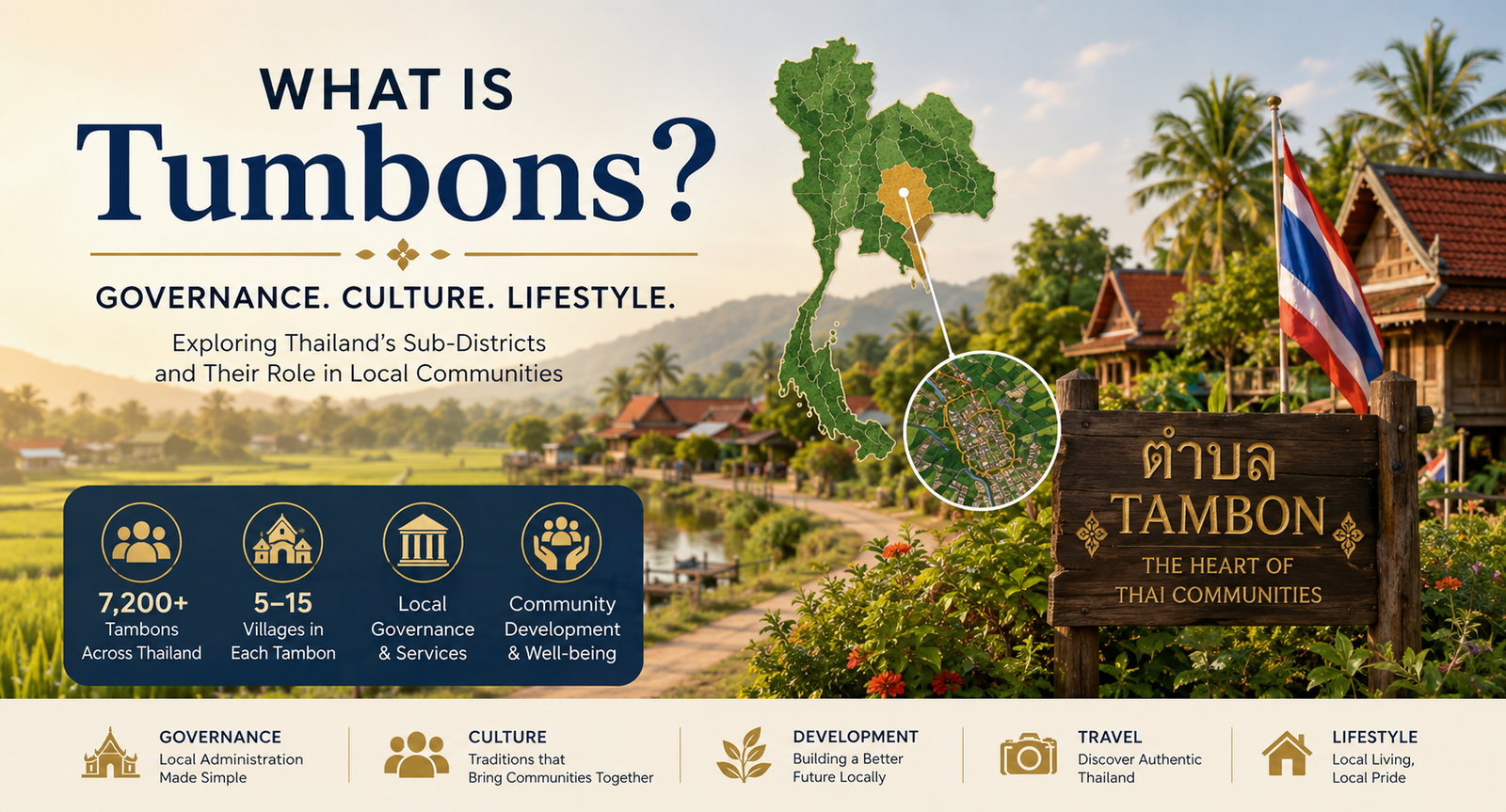
Thailand’s administrative system is organized into several levels to ensure efficient governance across the country. One of the most important yet often overlooked parts of this structure is the tambon. If you’ve ever researched Thailand’s provinces or districts, you’ve likely encountered this term.
A tumbon is a local administrative subdivision that connects district governments with individual villages. While it may seem like a simple geographic division, tumbons play a significant role in public services, local development, and community administration.
This guide explains what tumbons are, how they function, and why they matter.
What Are Tumbons?
A tambon is the third level of Thailand’s administrative hierarchy. It is commonly translated into English as a sub-district.
Every tambon belongs to a larger district, known in Thai as an amphoe, while each district belongs to a province (changwat).
The administrative hierarchy looks like this:
- Country
- Province (Changwat)
- District (Amphoe)
- Tambon (Sub-district)
- Village (Muban)
Thailand has more than 7,200 tumbons, making them one of the country’s most important local administrative units.
Why Are Tumbons Important?
Tumbons serve as the bridge between district authorities and local communities.
Their responsibilities include:
- Coordinating local development projects
- Managing community infrastructure
- Supporting healthcare initiatives
- Promoting education
- Maintaining public facilities
- Organizing environmental projects
- Assisting disaster response efforts
Because they operate close to local communities, tumbons often understand residents’ needs better than higher levels of government.
How Many Villages Are in a Tambon?
A tambon generally contains between five and fifteen villages, known as muban.
Each village has its own village head responsible for local administration and communication with tambon officials.
Although the exact number varies across Thailand, this structure allows services to be delivered efficiently to both urban and rural communities.
Local Government Within Tumbons
Many tumbons are administered by a Tambon Administrative Organization (TAO).
These organizations are responsible for managing local budgets and public services.
Typical responsibilities include:
- Road maintenance
- Waste collection
- Water management
- Community health programs
- Parks and public spaces
- Local economic development
- Cultural preservation
Residents often elect local representatives, giving communities a direct role in decision-making.
Tumbons and Municipalities
Not every tambon is governed in exactly the same way.
Some areas fall under municipalities, especially urban locations. In these cases, municipal governments take over responsibilities that would otherwise belong to the Tambon Administrative Organization.
As cities expand, governance structures may change while administrative boundaries remain in place.
Difference Between Tambon and Amphoe
Many people confuse these two administrative terms.
| Tambon | Amphoe |
|---|---|
| Sub-district | District |
| Smaller administrative area | Larger administrative division |
| Contains villages | Contains multiple tumbons |
| Focuses on local community administration | Oversees broader district management |
Simply put, several tumbons together form one amphoe.
Tumbons and Daily Life
Although many travelers never notice administrative boundaries, tumbons influence everyday life across Thailand.
Examples include:
- Local schools
- Community healthcare centers
- Agricultural support programs
- Road construction
- Public utilities
- Emergency services
- Community events
For Thai citizens, the tambon is often the first point of contact for many local government services.
Why Travelers May Encounter Tumbons
Visitors researching destinations in Thailand may notice tambon names in:
- Hotel addresses
- Government documents
- Google Maps
- Land records
- Property listings
- Business registrations
Understanding tumbons helps travelers better interpret Thai addresses and navigate administrative information.
Tumbons in Rural Development
Tumbons play an especially important role in rural Thailand.
They support initiatives such as:
- Agricultural development
- Water resource management
- Small business promotion
- Community tourism
- Environmental conservation
- Infrastructure improvement
These local programs help strengthen regional economies while preserving community traditions.
Digital Administration and Modernization
Thailand has gradually modernized local administration through digital services.
Many tambon offices now support:
- Online public information
- Digital record management
- Local service requests
- Community announcements
- Administrative documentation
Digital transformation is helping local governments improve efficiency while making services more accessible.
Benefits of the Tambon System
The tambon structure offers several advantages.
Community Representation
Residents have greater opportunities to participate in local decision-making.
Better Service Delivery
Local governments can respond more quickly to community needs.
Local Development
Projects can be designed around regional priorities instead of applying one solution nationwide.
Cultural Preservation
Tumbons help protect local traditions, festivals, and community identity.
Challenges Facing Tumbons
Like many local governments worldwide, tumbons face certain challenges.
Some common issues include:
- Limited financial resources
- Population shifts toward cities
- Infrastructure demands
- Administrative modernization
- Environmental management
- Balancing development with cultural preservation
Despite these challenges, tumbons remain a cornerstone of Thailand’s governance system.
Interesting Facts About Tumbons
- Thailand has more than 7,200 tumbons.
- Most tumbons contain multiple villages.
- They represent the third administrative level in Thailand.
- Many are managed by elected Tambon Administrative Organizations.
- Tumbons support local infrastructure, education, healthcare, and development projects.
Frequently Asked Questions
What is a tambon?
A tambon is a sub-district in Thailand and serves as the country’s third-level administrative division below districts.
How many tumbons are there in Thailand?
Thailand has over 7,200 tumbons distributed across its provinces.
What is the difference between a tambon and a village?
A tambon contains several villages (muban). Villages are the smallest administrative units.
Who manages a tambon?
Many tumbons are governed by a Tambon Administrative Organization (TAO), while some urban areas fall under municipal governments.
Why are tumbons important?
Tumbons help deliver local government services, manage community development projects, and represent residents at the grassroots level.
Final Thoughts
Tumbons are a fundamental part of Thailand’s administrative system, connecting national policies with local communities. While they may appear to be simple sub-districts on a map, they play a central role in governance, public services, infrastructure, and community development.
Whether you’re studying Thailand’s government structure, researching Thai addresses, investing in property, or planning a visit, understanding how tumbons work provides valuable insight into how the country is organized at the local level.
Read More About: Streameast
