
The term marital status appears in many places, from government applications and employment forms to surveys, financial documents, medical records, and online profiles. Although it sounds straightforward, people sometimes wonder what the different options mean and which one they should select.
In simple terms, marital status indicates whether a person is currently married or has another legally recognized relationship status. The appropriate answer depends on your current legal circumstances and, in some cases, the rules of the organization asking the question.
Understanding these categories can help you complete forms accurately and avoid confusion. It is also useful to know that marital status is not necessarily the same thing as relationship status. Someone can be in a long-term relationship without being legally married.
This guide explains the meaning of marital status, common categories, how to answer the question on forms, and why organizations may request this information.
What Is Marital Status?
Marital status is a person’s legal status in relation to marriage. It generally identifies whether someone is married, unmarried, divorced, widowed, separated, or in another legally recognized relationship category.
The exact definition can depend on the country and the purpose of the document. For example, a government form may focus strictly on legal marital status, while a survey may provide broader relationship categories.
A person’s marital status can change over time. Someone who is single may later become married, while a married person may become divorced or widowed.
Is Marital Status the Same as Relationship Status?
No. The two terms are related but not identical.
Marital status generally focuses on legal marriage, whereas relationship status can describe a person’s broader romantic or domestic situation.
For example:
- A person may be single but dating someone.
- A couple may live together without being married.
- Someone may be legally married but separated from their spouse.
- A divorced person may be in a new relationship without being remarried.
When completing an official form, use the categories and definitions provided by that organization rather than assuming that relationship status and marital status mean the same thing.
Common Types of Marital Status
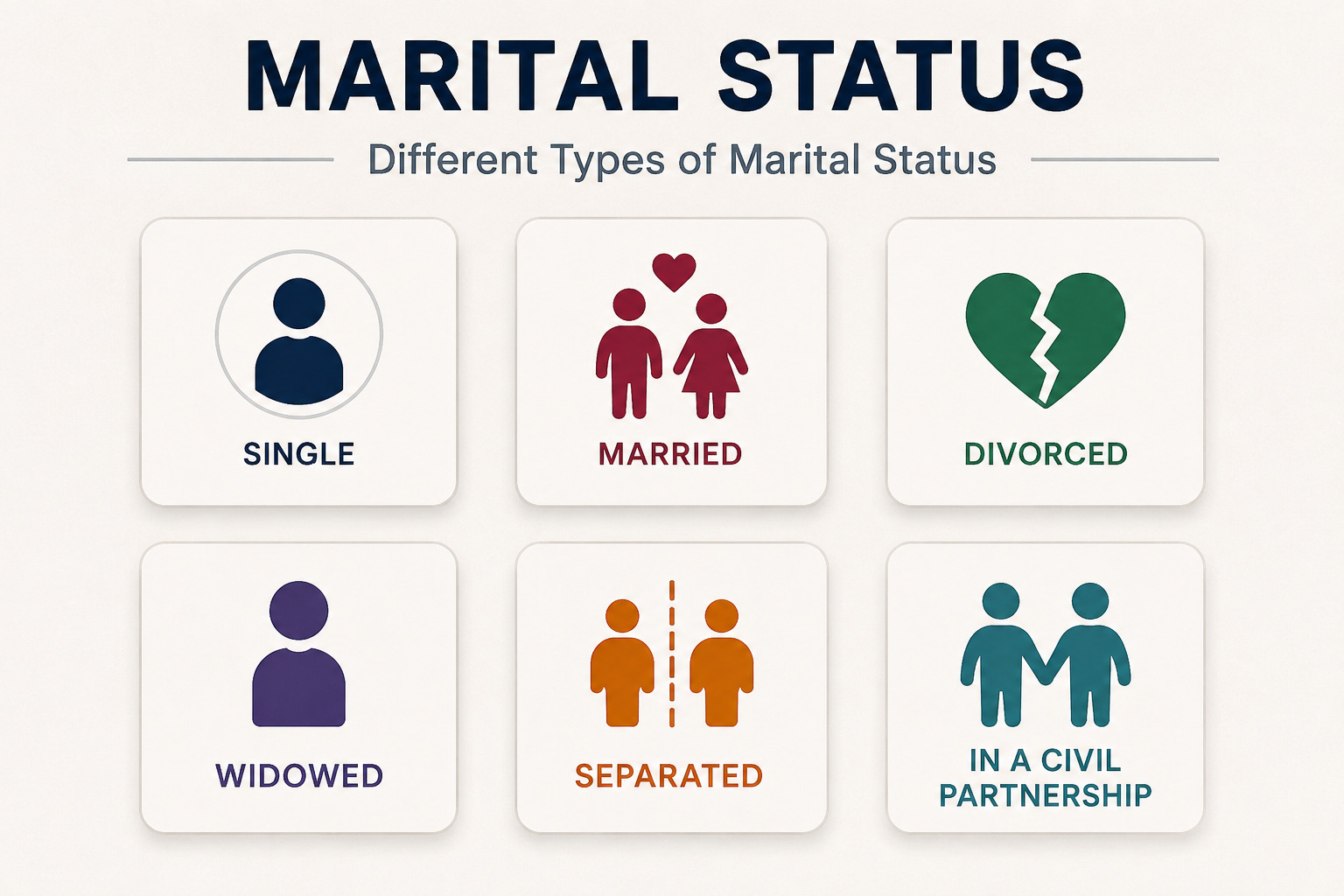
Different forms may use different categories, but the following are among the most common.
| Marital Status | General Meaning |
| Single | Not currently married |
| Married | Legally married to a spouse |
| Divorced | Marriage has legally ended through divorce |
| Widowed | Spouse has died and the person has not remarried |
| Separated | Married but living separately or legally separated, depending on the jurisdiction |
| Civil Partnership | In a legally recognized partnership where applicable |
| Domestic Partnership | A recognized partnership category in some jurisdictions |
Single
A person is generally considered single when they are not currently married. Depending on the form, “single” may include people who have never married and, in some contexts, people whose previous marriage has ended.
However, if a form separately lists “divorced” or “widowed,” those categories may be more appropriate.
Married
“Married” normally means that a person is legally married under the applicable law.
Marriage may involve legal rights and responsibilities relating to areas such as property, taxation, inheritance, family matters, and financial obligations. These consequences vary by jurisdiction.
Divorced
A person is divorced when their marriage has legally ended through a divorce process.
If a form offers both “single” and “divorced,” a divorced person would usually select divorced because it more accurately describes their marital history and current legal status.
Widowed
A widowed person is someone whose spouse has died and who has not subsequently remarried.
Some official forms specifically include “widowed” as a separate category, while others may use broader classifications.
Separated
Separation can be more complicated because its legal meaning varies.
A couple may be separated informally by living apart, while some jurisdictions recognize a formal legal separation. If a form provides a definition, follow that definition carefully.
Marital Status vs. Relationship Status
These terms are often confused.
| Term | What It Usually Describes |
| Marital status | Legal status concerning marriage |
| Relationship status | Romantic or personal relationship situation |
| Civil status | A broader legal classification that may include marriage and other personal-status information |
For example, a person who has a boyfriend or girlfriend may still have a marital status of single if they are not legally married.
This distinction becomes especially important when completing official paperwork.
How to Answer “What Is Your Marital Status?”
If you encounter the question “What is your marital status?”, first look at the available options.
A simple approach is:
- Read the definitions carefully.
- Identify your current legal status.
- Choose the category that most accurately matches it.
- If the form is official, don’t substitute relationship status for legal status.
- Ask the relevant organization if none of the options accurately describes your situation.
Example
Suppose a form provides these options:
- Single
- Married
- Divorced
- Widowed
- Separated
If you have never been married, “Single” would generally be the appropriate selection.
If your marriage legally ended through divorce, “Divorced” would normally be more precise than “Single.”
Why Is Marital Status Asked?
Organizations may request marital status for administrative, legal, statistical, or eligibility-related reasons.
Depending on the context, it may be relevant to:
- Government records
- Tax-related matters
- Insurance applications
- Employment records
- Benefits administration
- Immigration paperwork
- Financial applications
- Census and demographic research
- Legal documents
The importance of marital status varies considerably by situation. A casual survey may ask about it for demographic analysis, while an official application may need the information for legal or administrative purposes.
Does Marital Status Affect Legal Rights?
It can. Marriage may create legal rights and responsibilities involving property, inheritance, taxes, benefits, family matters, and other areas.
However, the specific consequences depend on the laws of the relevant jurisdiction. Civil partnerships and other legally recognized relationships may also carry particular rights or responsibilities.
For important legal or financial decisions, rely on the applicable law or qualified professional advice rather than assuming that a marital-status category has the same consequences everywhere.
Marital Status on Official Forms
When entering marital status on an official form, accuracy matters.
Some forms may ask only whether you are married or unmarried. Others may provide several categories. Still others may ask for information about a spouse, previous marriage, or date of marriage.
Tips for Completing a Form
- Use the options provided by the form.
- Read any instructions or definitions.
- Don’t select “married” simply because you are in a serious relationship.
- If you are separated, check whether the form distinguishes legal separation from living apart.
- If your circumstances don’t fit any listed option, contact the organization for clarification.
- Keep supporting legal documents available when a formal application requires them.
Examples of Marital Status
Here are a few simple examples:
Example 1:
Alex has never been married and is currently dating. Alex’s marital status would generally be single.
Example 2:
Maria is legally married and lives with her spouse. Her marital status is married.
Example 3:
Daniel’s marriage was legally ended through divorce. If a form offers “divorced,” that is generally the most accurate choice.
Example 4:
Sara’s spouse died, and she has not remarried. Her marital status is generally widowed.
These examples are simplified. Official definitions can differ depending on the country and the purpose of the form.
Key Takeaways
- Marital status describes a person’s legal status concerning marriage.
- Common categories include single, married, divorced, widowed, and separated.
- Marital status is not necessarily the same as relationship status.
- The correct answer depends on the wording and options provided on a form.
- Legal definitions can vary between countries and jurisdictions.
- For official documents, provide accurate information and follow the organization’s definitions.
- Marriage can affect certain legal, financial, tax, inheritance, and benefit-related matters.
FAQs
1. What does marital status mean?
Marital status refers to a person’s legal status concerning marriage. Common categories include single, married, divorced, widowed, and separated.
2. What should I write for marital status if I am not married?
If you have never been married and the form provides “Single” as an option, that is generally the appropriate choice. Always follow the specific definitions provided on the form.
3. Is dating considered a marital status?
Usually, no. Dating is generally considered a relationship status rather than a legal marital status. A person can be dating while still legally classified as single.
4. What is the marital status of a divorced person?
A person whose marriage has legally ended through divorce is generally considered divorced. If a form provides a separate divorced category, it is usually more precise than selecting “single.”
5. What does widowed mean?
Widowed generally means that a person’s spouse has died and the person has not remarried.
6. What does separated mean in marital status?
Separated generally means that spouses are living apart or have separated their marital relationship. The exact legal meaning varies by jurisdiction, so official forms should be completed according to their instructions.
7. Can marital status change?
Yes. Marital status can change following events such as marriage, divorce, or the death of a spouse. The legal date and process for a change depend on the applicable jurisdiction.
8. Why do employers ask for marital status?
An employer or HR department may request personal-status information for administrative, benefits, insurance, or record-keeping purposes. Whether an employer should collect or use such information depends on local laws and workplace policies.
Conclusion
Understanding marital status is important whenever you encounter it on an official form, application, survey, or personal record. Although the basic categories are familiar, their exact definitions can vary depending on the country, legal system, and purpose of the document.
The safest approach is to focus on your current legal status, read the form’s instructions carefully, and choose the category that accurately represents your circumstances. If none of the available options seems appropriate, contacting the organization responsible for the form is better than guessing.
Learn More About: Martyn Eaden
