
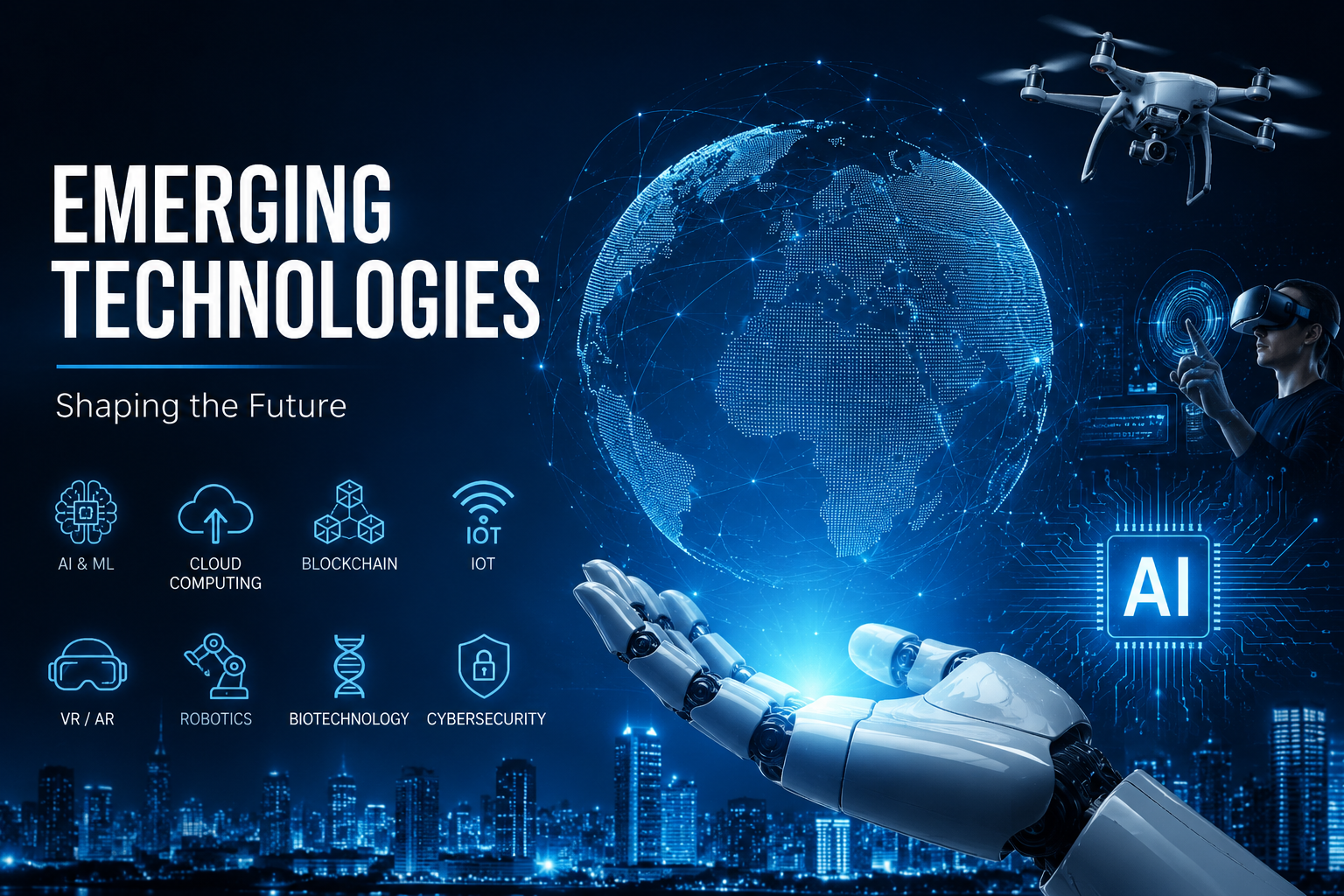
Technology rarely stands still. A tool that seems experimental today can become part of everyday life within a few years. From artificial intelligence and robotics to quantum computing and biotechnology, new innovations are changing how people work, communicate, travel, shop, and solve problems.
The term emerging technologies refers to technologies that are still developing, gaining adoption, or creating new possibilities. Some are already being used commercially, while others remain in research and development.
Understanding these technologies matters because they can create new business opportunities, improve productivity, reshape jobs, and introduce challenges that organizations need to prepare for. The key is not simply knowing what is new, but understanding where a technology can provide genuine value.
What Are Emerging Technologies?
Emerging technologies are innovations that are relatively new, rapidly evolving, or moving from experimental development toward wider adoption.
They can include new software systems, computing methods, scientific discoveries, connected devices, and engineering solutions.
Some technologies develop gradually, while others can advance quickly because of improvements in computing power, data availability, investment, and research.
Common examples include:
- Artificial intelligence and machine learning
- Quantum computing
- Robotics and autonomous systems
- Biotechnology
- Extended reality
- Blockchain and decentralized technologies
- Internet of Things (IoT)
- Edge computing
- Advanced cybersecurity
- Renewable energy technologies
The important point is that “emerging” does not necessarily mean “brand new.” A technology can remain emerging while its capabilities, applications, and commercial uses continue to develop.
Why Emerging Technologies Matter
Emerging technology can affect much more than the technology sector. It can influence healthcare, finance, manufacturing, transportation, education, retail, agriculture, and almost every other major industry.
For businesses, adopting the right innovation can help them:
- Automate repetitive processes
- Reduce operating costs
- Analyze information more effectively
- Improve customer experiences
- Develop new products and services
- Strengthen cybersecurity
- Make faster, data-informed decisions
For individuals, new technologies can provide better digital tools, personalized services, improved communication, and greater access to information.
However, adoption should not happen simply because something is described as “the next big thing.” Organizations need to consider cost, security, reliability, regulation, workforce requirements, and measurable business value.
Top Emerging Technologies to Watch
1. Artificial Intelligence and Machine Learning
Artificial intelligence remains one of the most influential areas of technological development.
AI systems can analyze large amounts of information, recognize patterns, generate content, assist with programming, support customer service, and automate specific business tasks.
Generative AI has expanded this impact by enabling systems to produce text, images, software code, audio, and other forms of content.
Businesses are increasingly exploring AI for:
- Customer support
- Data analysis
- Marketing
- Software development
- Fraud detection
- Document processing
- Business automation
The biggest opportunity may come from using AI alongside human expertise rather than treating it as a complete replacement for people.
2. Quantum Computing
Quantum computing uses principles of quantum mechanics to process information in fundamentally different ways from conventional computers.
It is still an emerging field, but researchers are exploring potential applications in areas such as optimization, materials science, chemistry, cryptography, and complex simulations.
Quantum computing is not expected to replace ordinary computers for everyday tasks. Instead, its potential lies in solving certain highly complex problems that are difficult for classical systems.
3. Robotics and Autonomous Systems
Robotics is moving beyond traditional factory automation.
Modern robots can increasingly use sensors, computer vision, AI, and sophisticated control systems to operate in changing environments.
Potential applications include:
- Manufacturing
- Warehousing
- Agriculture
- Healthcare
- Logistics
- Space exploration
- Inspection and maintenance
Autonomous systems may also transform transportation and delivery services as hardware and software continue to improve.
4. Biotechnology and Synthetic Biology
Advances in biotechnology are creating new possibilities in medicine, agriculture, environmental science, and industrial production.
Researchers are exploring technologies that can help develop treatments, improve crops, create biological materials, and produce useful compounds more efficiently.
Synthetic biology is particularly interesting because it involves designing or modifying biological systems for specific purposes.
The field also raises important questions about safety, ethics, regulation, and responsible research.
5. Extended Reality
Extended reality includes virtual reality (VR), augmented reality (AR), and mixed reality (MR).
These technologies can blend digital information with physical environments or create immersive virtual experiences.
Beyond gaming and entertainment, potential applications include:
- Employee training
- Education
- Product visualization
- Healthcare
- Engineering
- Remote collaboration
- Retail experiences
As hardware becomes more capable and comfortable, extended reality could become increasingly useful for professional applications.
6. Internet of Things and Edge Computing
The Internet of Things connects physical devices to networks so they can collect, exchange, and process information.
Smart sensors can monitor machines, buildings, vehicles, farms, and industrial equipment.
Edge computing complements IoT by processing data closer to where it is generated rather than sending everything to a distant data center.
This can help reduce latency and support applications that require fast responses.
7. Advanced Cybersecurity
As digital systems become more connected, cybersecurity becomes increasingly important.
Emerging cybersecurity technologies focus on identifying threats, protecting identities, securing connected devices, and responding to attacks more quickly.
AI-assisted threat detection, zero-trust security models, automated monitoring, and post-quantum cryptography are examples of areas receiving significant attention.
Security should be built into technology projects from the beginning rather than added as an afterthought.
8. Blockchain and Decentralized Technologies
Blockchain technology provides a way to record transactions and information across distributed networks.
Although blockchain became widely associated with cryptocurrencies, its potential applications extend to areas such as digital identity, supply-chain tracking, asset management, and certain financial services.
Its usefulness depends heavily on the specific problem being solved. Blockchain is not automatically the best solution simply because a project involves digital records.
9. Clean Energy and Advanced Energy Storage
Energy technology is another important area of innovation.
Advances in batteries, solar power, grid management, energy storage, and other clean-energy systems could support more efficient and resilient energy infrastructure.
Better storage technology is especially important because it can help manage the intermittent nature of renewable energy sources.
10. Advanced Connectivity
Next-generation connectivity technologies are improving how devices, people, and systems communicate.
Faster networks can support applications involving connected vehicles, smart factories, remote services, immersive experiences, and large numbers of IoT devices.
Connectivity becomes particularly valuable when combined with AI, edge computing, automation, and real-time data processing.
How Emerging Technologies Are Changing Industries
The impact of new technology becomes easier to understand when viewed through real-world applications.
| Industry | Potential Technology Impact |
| Healthcare | AI-assisted analysis, robotics, biotechnology |
| Finance | Fraud detection, automation, digital identity |
| Manufacturing | Smart factories, robotics, predictive maintenance |
| Retail | Personalization, computer vision, automation |
| Agriculture | Smart sensors, robotics, precision farming |
| Education | AI tutoring, immersive learning, digital platforms |
| Transportation | Autonomous systems, connected infrastructure |
| Energy | Smart grids, advanced batteries, renewable systems |
For example, a manufacturer can combine IoT sensors, edge computing, and AI to monitor equipment and identify potential maintenance issues before a major failure occurs.
In another setting, a retailer could use AI to improve product recommendations while using stronger cybersecurity systems to protect customer information.
The value comes from combining technologies with a clear business objective.
Technology Information Should Be Practical
As new technologies appear, people need reliable information that explains what these innovations actually mean.
A technology resource such as Geekzilla io Tech, for example, focuses on accessible technology information covering areas such as gadgets, AI, software, gaming, cybersecurity, and digital trends. Its practical approach demonstrates why technology content is most useful when it explains not only what a technology does, but also why it matters to everyday users.
That distinction is important. A long list of technical specifications does not necessarily help someone decide whether a product, platform, or emerging technology is relevant to them.
Good technology content should answer practical questions:
- What problem does it solve?
- Who benefits from it?
- What are its limitations?
- Is it ready for widespread use?
- What risks should users understand?
- What could change in the next few years?
Benefits and Challenges of Emerging Technologies
Emerging technologies can create major advantages, but innovation also comes with risks.
Major Benefits
- Greater productivity
- Faster data analysis
- Improved automation
- New business models
- Better communication
- More personalized services
- Scientific and medical advances
- Potential environmental improvements
Important Challenges
- Privacy concerns
- Cybersecurity threats
- High implementation costs
- Skills shortages
- Regulatory uncertainty
- Ethical concerns
- Digital inequality
- Reliability and technical limitations
Responsible adoption requires balancing opportunity with risk.
How Businesses Can Prepare
Companies do not need to adopt every new technology. A better strategy is to identify technologies that solve genuine problems.
A practical approach is:
- Identify a business problem. Start with a measurable need rather than a technology trend.
- Research available solutions. Compare different tools and providers.
- Run a small pilot. Test the technology before making a large investment.
- Measure results. Track productivity, cost, quality, security, or customer outcomes.
- Train employees. Make sure teams understand both the benefits and limitations.
- Review security and compliance. Assess privacy, data protection, and regulatory requirements.
- Scale carefully. Expand only when the technology delivers meaningful results.
This approach reduces unnecessary spending while allowing organizations to benefit from genuine innovation.
Another useful resource for exploring digital topics is Merfez, which covers areas including artificial intelligence, software, cybersecurity, SEO, and digital marketing. This broader technology perspective can help readers connect emerging innovations with practical online and business applications.
Key Takeaways
- Emerging technologies are rapidly developing innovations with the potential to change how industries operate.
- AI, quantum computing, robotics, biotechnology, IoT, cybersecurity, and clean energy are important areas to watch.
- Not every new technology is ready for widespread adoption.
- Businesses should focus on solving real problems instead of following trends blindly.
- Security, privacy, ethics, cost, and workforce skills should be considered before implementation.
- The most valuable technologies are those that create measurable benefits for people and organizations.
FAQs
What are emerging technologies?
Emerging technologies are new or rapidly developing innovations that may significantly influence industries, businesses, or everyday life.
What is the most important emerging technology?
Artificial intelligence is currently one of the most influential emerging technology areas because of its broad range of applications.
Is quantum computing ready for everyday use?
Not yet. Quantum computing is still developing and is mainly focused on specialized research and potential future applications.
How do emerging technologies affect businesses?
They can improve automation, productivity, customer experiences, data analysis, and product development.
What are the risks of emerging technologies?
Common risks include privacy problems, cybersecurity threats, high costs, ethical concerns, and regulatory uncertainty.
Should every business adopt new technology?
No. Businesses should adopt technology when it solves a genuine problem and provides measurable value.
Why is cybersecurity important for new technologies?
New connected systems can create additional security risks, making strong protection and responsible data management essential.
Conclusion
Emerging technologies are not simply futuristic concepts. Many are already influencing the way businesses operate and how people interact with digital services.
Artificial intelligence, robotics, biotechnology, quantum computing, connected devices, advanced cybersecurity, and clean energy are developing at different speeds, and their long-term impact will depend on how responsibly they are implemented.
