
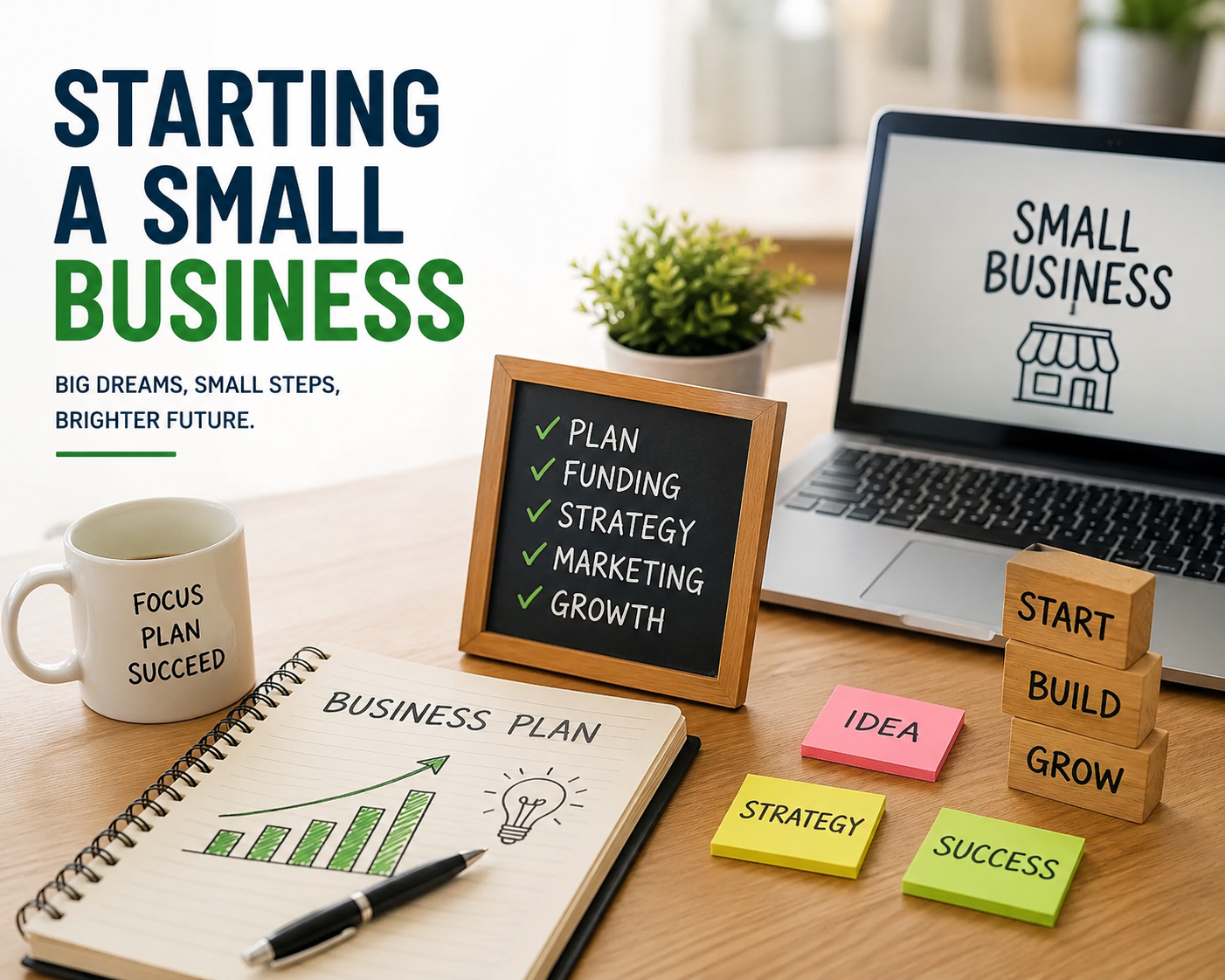
Starting a small business can be exciting, but it can also feel overwhelming when you are unsure where to begin. You may have a great idea, useful skills, or a product you believe customers will want, yet turning that idea into a real business requires more than enthusiasm.
The good news is that you do not necessarily need a large office, a big team, or substantial capital on day one. Many successful businesses begin with one person, a small budget, and a clearly defined customer problem.
The key is to start with a practical plan. Before spending heavily on branding, equipment, inventory, or advertising, determine whether people actually need what you plan to sell.
This guide explains the major steps involved in starting a small business, from choosing an idea and researching the market to managing finances and attracting your first customers.
Complete Guide to Starting a Small Business
What Does Starting a Small Business Involve?
Starting a small business means turning a product, service, skill, or solution into an organized commercial activity.
Although every business is different, the process usually includes:
- Choosing a viable business idea
- Identifying your target customers
- Researching competitors
- Creating a business plan
- Estimating startup and operating costs
- Choosing an appropriate legal structure
- Completing required registrations and licenses
- Setting up business finances
- Creating a marketing strategy
- Finding and retaining customers
The exact legal, tax, licensing, and registration requirements depend on where you operate. Always check the rules that apply to your location and industry before launching.
Choose the Right Business Idea
A strong business idea does not have to be completely original. It needs to solve a real problem or provide something customers genuinely value.
For example, you could start a:
- Digital marketing service
- Freelance writing business
- Online consulting service
- E-commerce store
- Web design company
- Bookkeeping service
- Cleaning business
- Virtual assistant service
- Home-based food business
- Social media management agency
If you need inspiration, you can explore these startup business ideas to compare different business models, startup requirements, and growth possibilities.
Ask These Questions Before Choosing
Before committing to an idea, consider:
- What problem does my business solve?
- Who is most likely to pay for the solution?
- How much will customers realistically pay?
- Who are my competitors?
- What skills or resources do I already have?
- How much money will I need to begin?
- Can the business eventually become profitable?
A simple business that solves a specific problem can be easier to test than an ambitious idea requiring significant investment.
Research Your Target Market
Market research helps you understand whether customers actually want your product or service.
Start by identifying your ideal customer. Consider their age, location, needs, buying habits, budget, and the problems they are trying to solve.
Then research competing businesses.
Look at:
- Their pricing
- Products or services
- Customer reviews
- Website and social media presence
- Strengths and weaknesses
- Common customer complaints
You do not need to copy competitors. Instead, look for opportunities to provide better service, clearer communication, greater convenience, stronger quality, or a more specialized solution.
Test Your Idea Before Spending Heavily
One of the smartest ways to reduce risk is to test your idea before making major investments.
For example, instead of purchasing hundreds of products for an online store, start with a small selection. Instead of renting an office immediately, test your service remotely if possible.
Early customer feedback can tell you what needs improvement before you commit more money.
Create a Simple Business Plan
A business plan does not have to be a 50-page document.
For a small business, a straightforward plan can answer the following:
| Area | What to Define |
|---|---|
| Business idea | What will you sell? |
| Target market | Who will buy it? |
| Customer problem | What need are you solving? |
| Pricing | How much will you charge? |
| Competition | Who already serves this market? |
| Marketing | How will customers find you? |
| Startup costs | How much money do you need? |
| Revenue | How will the business make money? |
| Goals | What do you want to achieve? |
This plan gives you a practical roadmap and makes it easier to identify financial problems before they become expensive mistakes.
Calculate Your Startup Costs
Understanding your numbers is one of the most important parts of starting a small business.
Depending on the business model, startup expenses may include:
- Business registration
- Licenses and permits
- Equipment
- Inventory
- Website development
- Software subscriptions
- Insurance
- Packaging
- Office or workspace costs
- Marketing
- Professional services
Separate one-time costs from recurring expenses.
For example, purchasing equipment may be a one-time expense, while website hosting, software, rent, and advertising may continue every month.
Also create a basic cash-flow forecast. Profit and cash flow are not always the same thing, and a business can face financial pressure even when sales appear healthy.
Choose a Business Structure and Register
Your business structure can affect taxes, liability, ownership, and administrative responsibilities.
Common structures include:
- Sole proprietorship
- Partnership
- Limited liability company
- Corporation
The available structures and requirements vary by country and region.
You may also need specific licenses or permits depending on your industry. Food businesses, financial services, healthcare-related businesses, transportation companies, and other regulated industries can have additional requirements.
Research the rules applicable to your location before accepting customers or selling products.
Separate Business and Personal Finances
Once your business begins operating, keep business transactions organized separately from personal spending whenever possible.
Consider establishing:
- A dedicated business bank account
- A reliable bookkeeping system
- Organized invoices and receipts
- A system for tracking expenses
- Regular financial reviews
Separating finances makes it easier to understand whether your business is actually making money and can simplify financial reporting.
Find Funding When Necessary
Not every small business requires outside financing. Some entrepreneurs can start using personal savings or by offering services that require very little equipment.
However, certain businesses need capital for inventory, equipment, employees, premises, technology, or expansion.
Funding options can include:
- Personal savings
- Business loans
- Lines of credit
- Equipment financing
- Grants
- Crowdfunding
- Angel investment
- Business credit cards
If you need a deeper overview of financing choices, this small business funding guide explains different funding types, what they can be used for, and factors to consider before accepting financing.
Do not borrow simply because money is available. First determine exactly how much you need, what you will use it for, and whether the business can comfortably manage the repayment.
Build Your Brand and Online Presence
A small business does not need an expensive brand identity to look professional.
Start with the basics:
- A clear business name
- A simple logo
- Consistent messaging
- A professional website
- Accurate contact information
- Business social media profiles where relevant
Your website should quickly explain what you offer, who you serve, why customers should choose you, and how they can contact or purchase from you.
For local businesses, consider creating a presence on relevant local directories and platforms. For online businesses, focus on useful content, search visibility, social media, referrals, and other channels that match your customers’ habits.
Get Your First Customers
Finding your first customers is often more challenging than creating the business itself.
Start with channels that match your target audience rather than trying everything at once.
Potential approaches include:
Referrals
Ask satisfied customers to recommend your business to people they know.
Content Marketing
Create useful articles, guides, videos, or social posts that answer questions your potential customers are already asking.
Social Media
Use platforms where your audience is active. Focus on useful content rather than constantly promoting your products.
Local Marketing
If you serve a specific geographic area, local partnerships, community events, and location-focused marketing can help generate awareness.
Direct Outreach
For business-to-business services, professional outreach can help you connect directly with potential clients.
The goal is not simply to generate attention. It is to find people who have a genuine need and can become paying customers.
Track Cash Flow and Business Performance
Once your business launches, monitor its performance regularly.
Useful numbers may include:
- Monthly revenue
- Operating expenses
- Gross profit
- Net profit
- Cash balance
- Customer acquisition cost
- Average order value
- Repeat customer rate
You do not need complicated analytics when you are just starting. A simple spreadsheet can provide valuable insight.
If one product generates strong sales but very little profit, for example, you may need to adjust pricing or reduce costs.
Common Mistakes to Avoid
Many small businesses struggle because of preventable mistakes rather than a lack of opportunity.
Avoid:
- Launching without researching customers
- Spending too much before validating demand
- Trying to serve everyone
- Ignoring cash flow
- Setting prices without calculating costs
- Mixing personal and business finances
- Relying on only one source of customers
- Expanding before the business is ready
- Ignoring legal or tax responsibilities
- Failing to listen to customer feedback
Starting small gives you room to learn. You can improve your offer as you gain real-world experience.
Key Takeaways
- Starting a small business begins with solving a genuine customer problem.
- You do not necessarily need a large budget to get started.
- Research your market before making significant investments.
- Create a simple business plan with realistic financial projections.
- Understand your local registration, licensing, tax, and legal requirements.
- Keep business finances organized and separate from personal spending.
- Consider funding only when it serves a specific business purpose.
- Test your product or service before scaling.
- Focus on customer satisfaction and repeat business.
- Track revenue, expenses, cash flow, and profitability regularly.
FAQs
1. How much money do I need to start a small business?
There is no universal amount. A service-based business may require only basic equipment, software, and marketing, while a retail or manufacturing business may require substantially more capital. Calculate your specific startup and monthly operating costs before deciding how much money you need.
2. What is the easiest small business to start?
Service-based businesses are often easier to launch because they can require less inventory and equipment. Freelancing, consulting, virtual assistance, writing, digital marketing, and similar services can be started on a relatively small scale.
3. Can I start a small business with no experience?
Yes, but you should understand the skills required to deliver your product or service. If you lack certain skills, consider training, working with an experienced partner, or starting with a simpler business model.
4. Do I need a business plan to start a small business?
A formal business plan may not be required for every small business, but having a simple written plan is highly useful. It helps you define your customers, pricing, expenses, marketing strategy, and financial goals.
5. Should I get a business loan when starting?
Not necessarily. If you can start with personal savings and keep expenses low, outside financing may not be necessary. If you need substantial capital, compare funding options carefully and make sure projected cash flow can support the financial commitment.
6. How can I get my first customers?
Start with people who are most likely to need your product or service. Referrals, local networking, content marketing, social media, partnerships, and direct outreach can all help. Focus on demonstrating value rather than simply promoting your business.
7. How long does it take for a small business to become profitable?
There is no standard timeline. Profitability depends on the business model, pricing, operating costs, customer demand, competition, and execution. Build realistic financial projections and monitor your actual results regularly.
Conclusion
Starting a small business does not require having everything figured out from day one. What matters is starting with a clear customer problem, researching the market, controlling costs, and testing your idea before making major commitments.
Begin with a manageable version of your business. Find out what customers actually want, improve your product or service based on feedback, and reinvest carefully as demand grows.
A strong business is built through consistent decisions rather than one big move. With realistic planning, responsible financial management, and a customer-first approach, a small idea can develop into a sustainable business over time.
