
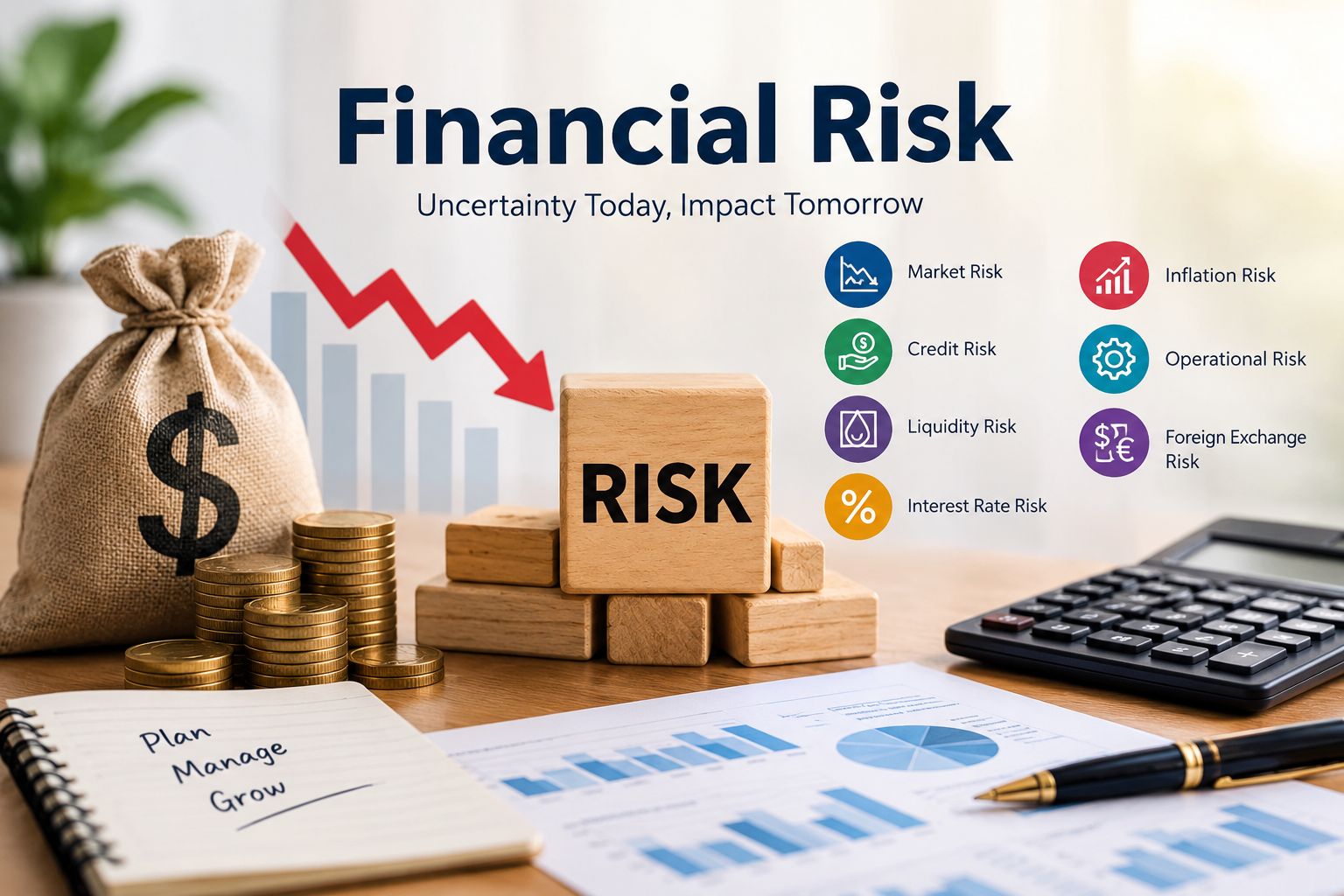
Financial decisions always involve some level of uncertainty. You may invest money expecting a return, lend money expecting repayment, or run a business expecting customers to pay on time. When the outcome is different from what you expected and creates a financial loss or difficulty, you are facing financial risk.
Financial risk affects individuals, businesses, banks, investors, and other organizations. A sudden market decline can reduce the value of investments, while excessive debt can make it difficult for a company or household to meet its financial obligations.
Understanding financial risk does not mean avoiding every possible risk. Instead, it means recognizing where losses could occur, estimating their potential impact, and taking sensible steps to reduce or manage them.
What Is Financial Risk?
Financial risk is the possibility that an individual, business, or organization will experience a financial loss because of uncertainty or an unfavorable event.
The risk can come from many sources, including changing market prices, unpaid debts, rising interest rates, cash shortages, fraud, economic conditions, or poor financial decisions.
For example, imagine a business borrows money to expand. If sales increase, the business may be able to repay the loan comfortably. However, if sales decline while loan payments remain due, the business faces financial risk.
Financial risk is therefore closely connected to uncertainty, potential loss, cash flow, debt, investments, and financial obligations.
Why Financial Risk Matters
Managing financial risk is important because even a financially healthy person or organization can experience unexpected losses.
For individuals, financial risk may affect:
- Savings and investments
- Ability to repay debt
- Emergency funds
- Retirement plans
- Purchasing power
- Household cash flow
For businesses, financial risk can affect:
- Revenue and profitability
- Cash flow
- Loan repayments
- Business expansion
- Supplier payments
- Long-term financial stability
The goal is not to eliminate every risk. Some risks cannot be completely avoided. The practical goal is to understand them and keep potential losses within a level that can be handled.
Types of Financial Risk
Financial risk can take several forms. The most common types include the following.
1. Market Risk
Market risk is the possibility that financial markets will move against you.
For investors, this may happen when the price of stocks, bonds, currencies, commodities, or other assets declines.
Example:
An investor purchases shares for $5,000. If the market price falls and the shares become worth $4,000, the investor has experienced a $1,000 decline in value.
Market risk can be influenced by economic conditions, interest rates, investor sentiment, company performance, and other factors.
2. Credit Risk
Credit risk is the possibility that a borrower will fail to repay money according to the agreed terms.
Banks face credit risk when they provide loans. Businesses can face it when customers purchase products or services on credit.
Example:
A company sells $20,000 worth of products to a customer with payment due in 60 days. If the customer cannot pay, the company may suffer a financial loss or cash-flow problem.
3. Liquidity Risk
Liquidity risk occurs when someone cannot quickly access enough cash to meet financial obligations.
An asset may have value but still be difficult to convert into cash quickly without accepting a significant discount.
Example:
A business owns expensive equipment but does not have enough cash to pay its employees or suppliers this month. The business may experience liquidity pressure even though its total assets are valuable.
4. Interest Rate Risk
Interest rate risk arises when changes in interest rates affect borrowing costs, investments, or financial obligations.
For example, a business with variable-rate debt may see its interest payments increase when borrowing rates rise.
Interest rate changes can also affect the value and attractiveness of certain investments.
5. Inflation Risk
Inflation risk is the possibility that rising prices will reduce the purchasing power of money.
Suppose you save $10,000, but prices rise significantly over several years. Even though your account still shows $10,000, that money may buy fewer goods and services than it did previously.
Inflation is particularly important for long-term financial planning.
6. Operational Risk
Operational risk comes from failures in internal processes, people, systems, or day-to-day operations.
Examples include:
- Accounting mistakes
- System failures
- Employee errors
- Cybersecurity incidents
- Poor internal controls
- Processing problems
Operational problems can create direct financial losses as well as additional costs for fixing the underlying issue.
7. Foreign Exchange Risk
Foreign exchange risk affects individuals and organizations that deal with more than one currency.
For example, a company based in one country may purchase goods in another currency. If exchange rates move unfavorably before payment is made, the company may have to pay more than expected.
Examples of Financial Risk
Financial risk can appear in everyday situations as well as complex financial activities.
| Situation | Type of Risk | Potential Impact |
|---|---|---|
| Stock prices fall | Market risk | Investment losses |
| Customer fails to pay | Credit risk | Lost revenue or cash flow |
| Business lacks available cash | Liquidity risk | Missed payments |
| Loan rates increase | Interest rate risk | Higher borrowing costs |
| Prices rise over time | Inflation risk | Lower purchasing power |
| Software or process fails | Operational risk | Financial and operational losses |
| Currency value changes | Foreign exchange risk | Higher transaction costs |
These examples show why financial risk is not limited to stock markets. It can affect almost every area where money is earned, borrowed, invested, transferred, or spent.
Causes of Financial Risk
Financial risk can develop because of internal decisions, external events, or a combination of both.
Common causes include:
- Economic changes – Recessions, inflation, and changing economic conditions can affect income, spending, and investments.
- High debt levels – Excessive borrowing can make financial obligations harder to manage.
- Market volatility – Asset prices can rise or fall unexpectedly.
- Poor cash-flow planning – A lack of available cash can create problems even when long-term assets are valuable.
- Concentration – Relying heavily on one customer, investment, supplier, or source of income can increase exposure to a single failure.
- Unexpected events – Natural disasters, system failures, fraud, or major business disruptions can create financial losses.
- Lack of financial information – Decisions based on incomplete or inaccurate information can increase uncertainty.
How to Manage Financial Risk
Effective financial risk management starts with identifying potential problems before they become major losses.
1. Build an Emergency Reserve
Maintaining accessible savings can help cover unexpected expenses and reduce the need to rely immediately on expensive borrowing.
The appropriate amount depends on income, expenses, financial responsibilities, and personal circumstances.
2. Diversify Investments
Diversification means spreading investments across different assets rather than concentrating everything in one investment.
For example, an investor may hold exposure to different asset classes, industries, or securities. Diversification cannot guarantee against losses, but it can reduce the impact of a poor performance from a single investment.
3. Control Debt
Borrowing can be useful, but excessive debt can increase financial pressure.
Before taking on new debt, consider:
- Interest costs
- Repayment period
- Monthly payment
- Income stability
- Other existing obligations
4. Monitor Cash Flow
Businesses should regularly track money coming in and going out.
A simple cash-flow review can help identify:
- Upcoming payments
- Outstanding invoices
- Recurring expenses
- Seasonal changes
- Potential cash shortages
5. Understand Investment Risk
Before investing, consider your financial goals, investment timeframe, and ability and willingness to tolerate losses.
An investment suitable for a long-term goal may not be appropriate for money that will be needed soon.
6. Use Appropriate Insurance
Insurance can transfer certain financial risks to an insurer in exchange for premiums. Depending on the situation, relevant coverage may include health, property, business, life, or other forms of insurance.
The right coverage depends on the specific risks and financial circumstances involved.
7. Review Financial Plans Regularly
Financial circumstances change. Income, expenses, debt, investments, and business conditions may all be different from what they were a year ago.
Regular reviews can help identify risks that were not obvious previously.
Financial Risk Management for Businesses
Businesses often use a structured process to manage financial risk.
A basic framework includes:
Identify → Assess → Prioritize → Control → Monitor
Identify
List possible financial threats, such as customer defaults, rising costs, currency movements, or cash shortages.
Assess
Estimate how likely each risk is and how serious the financial impact could be.
Prioritize
Focus attention on risks that could create significant damage to the organization.
Control
Use appropriate measures such as diversification, contracts, insurance, cash reserves, internal controls, or hedging strategies where suitable.
Monitor
Financial risk management is an ongoing process. Businesses should review their risk exposure as market and operating conditions change.
Financial Risk vs. Investment Risk
Financial risk is a broad concept, while investment risk is more specifically related to the possibility that an investment will lose value or produce a different return than expected.
For example, a business facing unpaid customer invoices is experiencing credit risk, which is a form of financial risk. An investor whose stock declines in value is experiencing investment-related market risk.
In simple terms:
- Financial risk: Broad category covering many potential financial losses.
- Investment risk: Risk specifically associated with investing money and expected returns.
Understanding the difference helps people use the right risk-management approach for the situation.
Key Takeaways
- Financial risk is the possibility of financial loss caused by uncertainty or unfavorable events.
- Common types include market, credit, liquidity, interest rate, inflation, operational, and foreign exchange risk.
- Financial risk can affect individuals, businesses, investors, and financial institutions.
- Diversification can help reduce concentration risk but cannot eliminate investment losses.
- Maintaining accessible savings can help manage unexpected financial needs.
- Controlling debt and monitoring cash flow are important parts of financial risk management.
- Investment decisions should consider goals, timeframe, and risk tolerance.
- Businesses should identify, assess, control, and regularly monitor financial risks.
FAQs
What is financial risk in simple words?
Financial risk is the possibility of losing money or experiencing financial difficulty because something does not happen as expected. It can come from investments, debt, cash-flow problems, market changes, or other financial events.
What are the main types of financial risk?
The main types include market risk, credit risk, liquidity risk, interest rate risk, inflation risk, operational risk, and foreign exchange risk. The relevant risks depend on the financial activity involved.
Why is financial risk management important?
Financial risk management helps individuals and organizations identify potential losses and take steps to reduce or control their impact. It can support better financial planning and reduce exposure to unexpected problems.
Can financial risk be completely eliminated?
No. Financial risk cannot always be eliminated. Investments can lose value, markets can change, and unexpected events can occur. Risk management focuses on understanding exposure and keeping potential losses manageable.
How can investors reduce financial risk?
Investors can consider diversification, appropriate asset allocation, their investment timeframe, and their risk tolerance. They should also understand the risks, costs, and characteristics of an investment before committing money.
What is the difference between risk and return?
Risk refers to uncertainty and the possibility that an investment or financial decision may produce a worse outcome than expected. Return refers to the gain or loss produced by that decision. In investing, greater potential returns are generally associated with greater risk.
Is financial risk only a business problem?
No. Individuals also face financial risks through investments, debt, inflation, employment income, unexpected expenses, and other financial decisions. Businesses generally face additional risks because of customers, suppliers, employees, borrowing, and operations.
Conclusion
Financial risk is an unavoidable part of managing money, investing, borrowing, and operating a business. The important step is not trying to remove every possible risk but understanding where financial losses could occur and preparing for them.
A strong approach starts with identifying risks, maintaining appropriate cash reserves, managing debt, diversifying investments, monitoring cash flow, and reviewing financial decisions regularly. For investments, understanding your goals, timeframe, and risk tolerance can also help you make more informed choices.
When financial risk is recognized early and managed systematically, individuals and businesses are better positioned to handle uncertainty and protect their long-term financial objectives.
Learn About: Investment Banking
