
Have you ever noticed how a busy shop can suddenly become quiet, or how companies that were hiring like crazy can start freezing new jobs a few months later? The economy has a rhythm like that too. Some periods feel energetic, with rising sales, more jobs, and strong business confidence. Then things cool down, sometimes slowly and sometimes all at once.
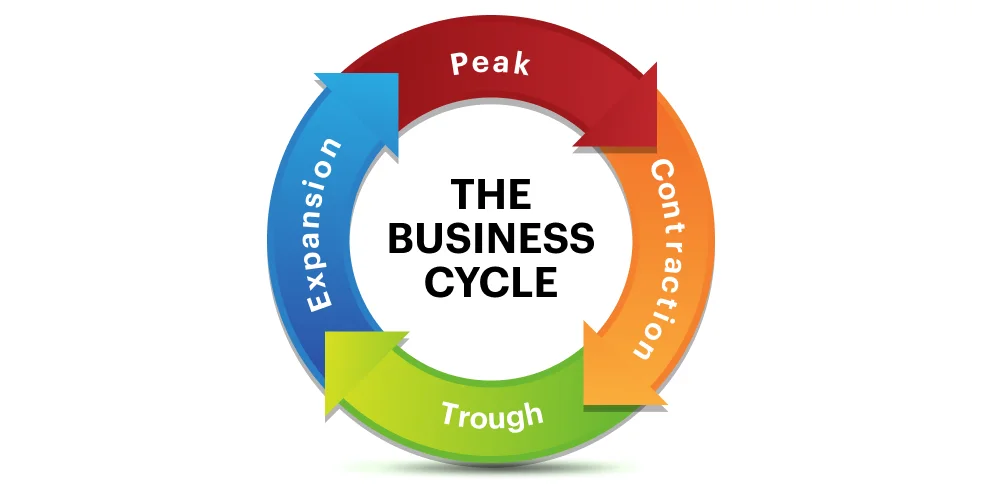
That repeated movement in economic activity is what economists call the business cycle. It helps explain why economies don’t grow at exactly the same pace year after year.
What Is a Business Cycle?
A business cycle is the pattern of rises and falls in overall economic activity over time. It affects businesses, workers, consumers, investors, and governments.
When the economy is growing, people generally have more income to spend, companies often sell more products, and businesses may invest in new equipment, stores, technology, or employees. When growth weakens, spending can fall, companies may delay investments, and unemployment can rise.
The important thing is that these changes aren’t perfectly predictable. Economic cycles can last for different lengths of time, and each one can look a little different.
The Four Main Stages
1. Expansion
Expansion is the period when economic activity is increasing.
Businesses may see stronger demand, which encourages them to produce more. Hiring can pick up, wages may rise, and consumers often feel more comfortable spending money.
Think about a small furniture company during a strong economy. Orders increase, the owner buys another delivery van, hires two workers, and perhaps opens a larger workshop. One company’s growth might seem small, but millions of similar decisions can add up across an economy.
2. Peak
A peak is the point where economic activity reaches a high level before growth begins to slow.
This doesn’t mean everything suddenly becomes bad. Quite the opposite. Businesses may still be making good money and people may still be spending. The difference is that the pace of growth starts losing momentum.
Sometimes prices also rise faster during strong periods because demand is high and businesses are competing for workers, materials, and other resources.
3. Contraction
During a contraction, economic activity starts declining.
Customers may become more careful with their money. Businesses can experience weaker sales and respond by cutting expenses, postponing expansion, or reducing hiring.
A mild contraction can pass without causing major disruption. A severe and prolonged decline may become a recession, bringing noticeably higher unemployment and weaker household spending.
4. Trough
The trough is the low point of the cycle. It marks the stage where economic activity stops falling and begins to stabilize.
This part can feel pretty uncomfortable in real life. A business owner might be worrying about cash flow, while a family may be putting off a car purchase or home renovation. But once conditions begin improving, spending and investment can gradually return.
That recovery then leads into another expansion.
What Causes Economic Cycles?
There isn’t one switch that turns an economy from strong to weak. Usually, several things happen at once.
Consumer Spending
Household spending is a huge part of economic activity. If people feel confident about their jobs and finances, they’re more likely to buy homes, cars, clothing, meals, and other goods and services.
But when people become worried about the future, they often save more and spend less. Businesses then feel the effect.
Interest Rates
Borrowing costs can change how much households and companies spend.
When interest rates are low, loans can become more affordable, which may encourage businesses to invest and consumers to make large purchases. Higher borrowing costs can have the opposite effect.
Business Investment
Companies don’t invest simply because the economy is growing. They also look at expected demand, financing costs, profits, and their confidence about the future.
If executives expect sales to weaken, they may hold back on new factories, equipment, or hiring.
Government Policies
Taxes, public spending, regulations, and other government decisions can influence economic activity. During difficult periods, governments may take steps designed to support demand and employment.
Central banks also play an important role through monetary policy.
Global Events
Modern economies are closely connected. A disruption in one major country can affect suppliers, exporters, manufacturers, and consumers elsewhere.
Energy price shocks, financial crises, wars, natural disasters, and major supply problems can all change the direction of economic activity.
Why Does the Business Cycle Matter?
For ordinary people, economic cycles aren’t just something discussed in an economics class.
They can affect whether a company is hiring, how easy it is to get a loan, whether house prices are rising, and how confident people feel about changing jobs.
For business owners, understanding the cycle can also improve decision-making. A company that’s expanding rapidly may need to ask whether its sales growth is sustainable before taking on a lot of debt.
On the other hand, a company that only cuts costs during a downturn might miss opportunities when competitors are pulling back.
There’s a balance to find.
How Businesses Can Prepare
No business can predict the next economic turning point perfectly. Still, a few habits can make difficult periods easier to handle.
Keep cash available. A healthy cash reserve gives a company breathing room when sales suddenly weaken.
Watch customer behavior. Sales numbers are useful, but changes in customer orders, payment patterns, and purchasing habits can provide early clues.
Avoid unnecessary debt. Debt can help a company grow, but large fixed payments become harder to manage when revenue falls.
Don’t depend on one customer or market. Diversification can reduce the damage caused by a slowdown in a particular industry.
Keep plans flexible. The best strategy during a strong economy may not make sense six months later.
Business Cycle vs. Economic Growth
These terms are sometimes mixed up, but they aren’t the same thing.
Economic growth refers to the long-term increase in the amount of goods and services an economy produces. The business cycle describes shorter-term fluctuations around that longer-term trend.
So an economy can experience several downturns and recoveries while still becoming larger and more productive over many years.
Technology, education, investment, infrastructure, and productivity can all contribute to long-term growth, even though short-term economic activity moves up and down.
A Simple Real-World Example
Imagine a local restaurant that’s doing extremely well.
Customers are coming in every evening. The owner hires more staff, orders additional supplies, and considers opening a second location.
Then household budgets tighten. Customers start eating out less often. The restaurant’s sales fall, so the owner reduces opening hours and postpones the second location.
Months later, confidence improves. Employment picks up, customers return, and sales begin climbing again.
That small story mirrors what happens on a much larger scale across industries and countries.
Frequently Asked Questions
What is the business cycle in simple words?
It’s the natural rise and fall of economic activity over time. Economies move through periods of expansion, peak activity, contraction, and recovery.
How long does a business cycle last?
There isn’t a fixed length. Some cycles are relatively short, while others can continue for many years. The causes and intensity of each cycle are different.
Is a recession the same as a contraction?
Not exactly. A contraction means economic activity is declining. A recession is a significant and broad downturn in economic activity. The two ideas are closely related, but they aren’t interchangeable in every context.
Can governments prevent economic cycles?
Governments and central banks can influence economic conditions and may try to soften severe downturns or prevent overheating. But completely eliminating economic fluctuations isn’t realistic.
Why should small businesses care about economic cycles?
Because changes in consumer spending, interest rates, employment, and business confidence can directly affect sales and costs. Knowing what’s happening in the wider economy can help a small business make better decisions about hiring, borrowing, inventory, and expansion.
Final Thoughts
Economic ups and downs are frustrating, especially when they affect someone’s job or a business they’ve spent years building. Still, cycles are a normal part of how modern economies behave.
The useful lesson isn’t trying to predict the exact month when the next downturn will arrive. That’s incredibly difficult. It’s about staying aware, keeping finances under control, and being ready to adjust when conditions change.
Once you understand the basic business cycle, economic headlines start making a lot more sense. You can see how consumer confidence, interest rates, employment, company investment, and government decisions are connected—and why a change in one area can eventually show up somewhere completely different.
Read More About: Business Types and Structures
