
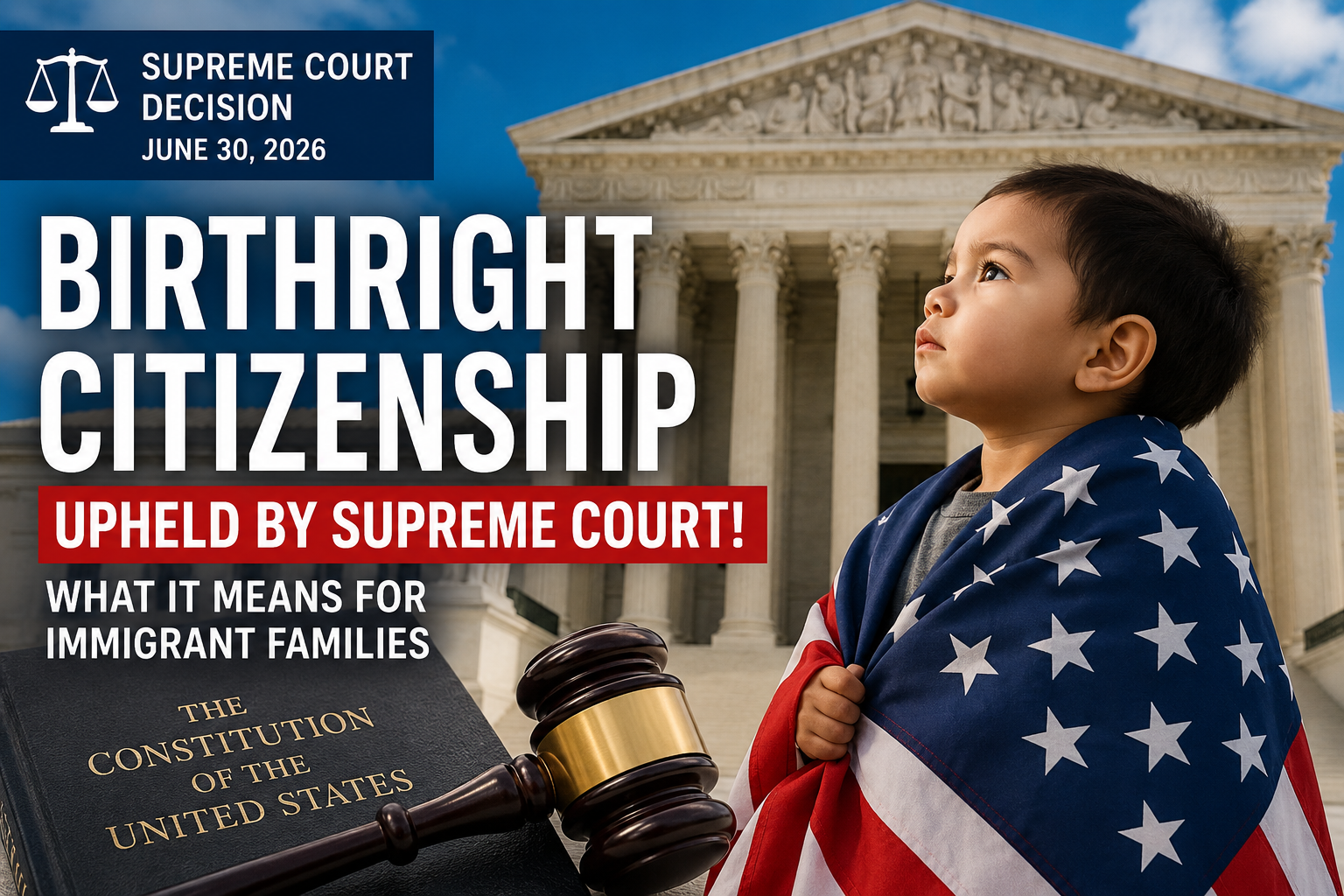
Have you ever wondered what actually makes someone a citizen of a country? For some people, it’s their parents. For others, it’s the place where they were born. That second idea is at the heart of one of the most talked-about immigration concepts in the United States: Birthright Citizenship.
At first glance, the idea seems pretty simple. A baby is born on U.S. soil, so the child becomes a U.S. citizen. But the legal history behind that simple statement is much more complicated. Questions about immigration, constitutional law, parental status, and government policy can all become part of the discussion.
And this isn’t just a debate happening in courtrooms or Washington offices. It affects real families, particularly parents who may have different immigration statuses from their children.
What Is Birthright Citizenship?
Birthright citizenship generally means that a person can receive citizenship because they were born within a particular country’s territory.
In the United States, the principle is closely connected to the 14th Amendment to the U.S. Constitution. Its Citizenship Clause states that people born or naturalized in the United States and subject to its jurisdiction are citizens.
That wording is important.
The concept doesn’t normally depend on whether a baby’s parents are wealthy, poor, immigrants, or long-term residents. The circumstances surrounding the parents can raise separate immigration questions, but citizenship at birth has historically been treated as a distinct legal issue.
For many families, this has made the United States different from countries that place greater emphasis on the citizenship or nationality of the parents.
How Did Birthright Citizenship Begin in the U.S.?
The roots of the modern American system go back to the aftermath of the Civil War.
Before the 14th Amendment was adopted in 1868, citizenship wasn’t defined in the same straightforward constitutional way. The amendment was designed in large part to establish citizenship protections after slavery and to clarify who could be considered a U.S. citizen.
The Citizenship Clause became especially significant because it established a constitutional foundation for people born in the country.
A major Supreme Court decision, United States v. Wong Kim Ark, later played an important role in interpreting birth-based citizenship. The case involved Wong Kim Ark, a man born in San Francisco to Chinese parents who were not U.S. citizens.
The Supreme Court ultimately recognized his U.S. citizenship.
That decision has remained an important part of the legal history surrounding citizenship by birth.
Does a Child Need American Parents to Become a Citizen?
Generally, no.
A common misunderstanding is that both parents, or at least one parent, must be a U.S. citizen for a child born in America to receive citizenship. That’s not how the traditional rule has worked.
The citizenship of the parents and the child’s citizenship are separate questions.
For example, imagine a couple living temporarily in the United States has a baby while they’re in the country. Under the long-standing interpretation of the Citizenship Clause, the child’s citizenship doesn’t simply depend on the parents holding U.S. passports.
Of course, immigration law can be complicated, and exceptions and specific circumstances matter. That’s why families dealing with unusual situations shouldn’t rely on a social media post or a casual explanation when making legal decisions.
Why Is Birthright Citizenship So Controversial?
This is where the subject gets complicated.
Supporters argue that citizenship based on birthplace creates a clear and consistent rule. They believe children shouldn’t be forced to carry the consequences of their parents’ immigration circumstances.
Critics, on the other hand, have raised concerns about unauthorized immigration and whether U.S. citizenship should automatically follow birth on American soil in every situation.
There’s also disagreement over how the Constitution should be interpreted today.
Some people see the existing system as a fundamental part of American citizenship law. Others believe Congress or the courts should reconsider how the Citizenship Clause applies in modern immigration circumstances.
And because the issue involves the Constitution, changes aren’t as simple as passing an ordinary policy at the local level.
Birthright Citizenship and Immigration Are Not the Same Thing
This distinction is easy to miss.
A child’s citizenship doesn’t automatically give the parents U.S. citizenship.
For instance, if a child is a U.S. citizen but the parents don’t have lawful immigration status, the parents don’t suddenly become citizens because of the child’s birth.
The child’s legal status and the parents’ immigration status can remain separate.
This matters because immigration discussions sometimes mix these two issues together. Citizenship, visas, green cards, deportation rules, and family-based immigration all operate under different legal frameworks.
Can a U.S.-Born Child Sponsor Parents?
People often hear that a U.S.-born child can eventually help their parents obtain legal status and assume that this happens immediately.
It doesn’t.
Under current U.S. immigration rules, a U.S. citizen generally must reach a certain age before being able to petition for parents. Even then, having a citizen child doesn’t guarantee that every immigration problem will disappear.
The family’s circumstances can matter a lot.
That’s one reason immigration attorneys often ask detailed questions before giving advice. A small fact about someone’s history can completely change the legal options available.
Why the 14th Amendment Matters
The 14th Amendment is central to the American understanding of citizenship by birth.
The amendment was adopted after the Civil War and addressed several major constitutional issues, including citizenship and equal protection.
Its Citizenship Clause has been interpreted over time through legislation and court decisions. Because the language is part of the Constitution, debates about changing its meaning can become especially significant.
That’s also why discussions about ending or limiting birthright citizenship aren’t simply ordinary immigration-policy arguments. They can involve constitutional interpretation at the highest level.
What Happens When a Child Is Born in the U.S.?
For a child born in the United States under circumstances covered by the citizenship rule, parents generally obtain documentation showing the child’s birth.
A birth certificate is an important record, although it isn’t itself the entire legal foundation of citizenship. Families may also need other documents later when applying for a passport, Social Security number, school records, or other services.
Parents should keep these documents somewhere safe.
It sounds like a small practical detail, but losing important birth and identity records can create unnecessary headaches years later.
Is Birthright Citizenship the Same in Every Country?
No.
Countries take different approaches to citizenship.
Some primarily follow jus soli, meaning citizenship connected to birthplace. Others emphasize jus sanguinis, where citizenship is primarily connected to the nationality or citizenship of the parents.
There are also countries that use a combination of both systems.
So if someone moves from one country to another, they shouldn’t assume the citizenship rules will work the same way. A child born abroad may have completely different citizenship rights depending on the country’s laws and the parents’ nationality.
The Debate Around Changing U.S. Citizenship Rules
The political debate over birthright citizenship has become increasingly intense over the years.
Some policymakers have argued that the United States should restrict automatic citizenship in certain circumstances, particularly when parents aren’t lawfully present in the country.
Others argue that such restrictions could conflict with the constitutional text and long-standing legal interpretation.
There are also practical concerns. Changing citizenship rules could affect families, government paperwork, immigration procedures, and the way citizenship is established for millions of people.
So while the phrase may sound simple, changing the underlying legal framework would be anything but simple.
Why This Issue Matters to Ordinary Families
Legal debates can feel distant until they affect someone you know.
Think about a child growing up in an American school, playing sports with classmates, making friends, and thinking of the United States as home. For that child, citizenship isn’t an abstract constitutional argument. It’s part of their everyday identity.
That’s why discussions about citizenship can become so emotional.
People aren’t only debating laws and policies. They’re often talking about where families belong, what rights children should have, and what it means to be American.
Final Thoughts
Birthright Citizenship is one of those topics that sounds straightforward until you look closely. Its roots reach back to the 14th Amendment, Supreme Court decisions, and America’s complicated history surrounding citizenship and equality.
The basic principle has traditionally connected citizenship to birth in the United States, but the political and legal debate surrounding that principle continues.
For families trying to understand their own situation, it’s worth looking beyond headlines. Immigration and citizenship law can be complicated, and individual circumstances matter.
The bigger question isn’t simply where someone was born. It’s also about how a country defines belonging, citizenship, and equal treatment—and those are questions that rarely have easy answers.
Frequently Asked Questions
What does Birthright Citizenship mean?
It generally refers to citizenship acquired because a person is born within a country’s territory. In the United States, the principle is closely connected to the Citizenship Clause of the 14th Amendment.
Is a baby born in the United States automatically a citizen?
Under the long-standing interpretation of U.S. citizenship law, most people born on U.S. soil are citizens at birth, subject to specific constitutional and legal considerations.
Do parents have to be U.S. citizens for their child to be a citizen?
No. A child’s citizenship at birth has traditionally been separate from the citizenship or immigration status of the parents.
Does having a U.S.-citizen child give parents automatic citizenship?
No. A child’s U.S. citizenship doesn’t automatically make the parents citizens or give them an immediate immigration status.
What is the 14th Amendment’s role in citizenship?
The 14th Amendment established the constitutional Citizenship Clause, which provides the foundation for citizenship for people born or naturalized in the United States and subject to its jurisdiction.
Can citizenship rules change?
Citizenship law can be affected by legislation, court decisions, and constitutional interpretation. However, changes involving constitutional rights can raise significant legal questions and may require extensive judicial review.
Learn About: Lifestyle India
