
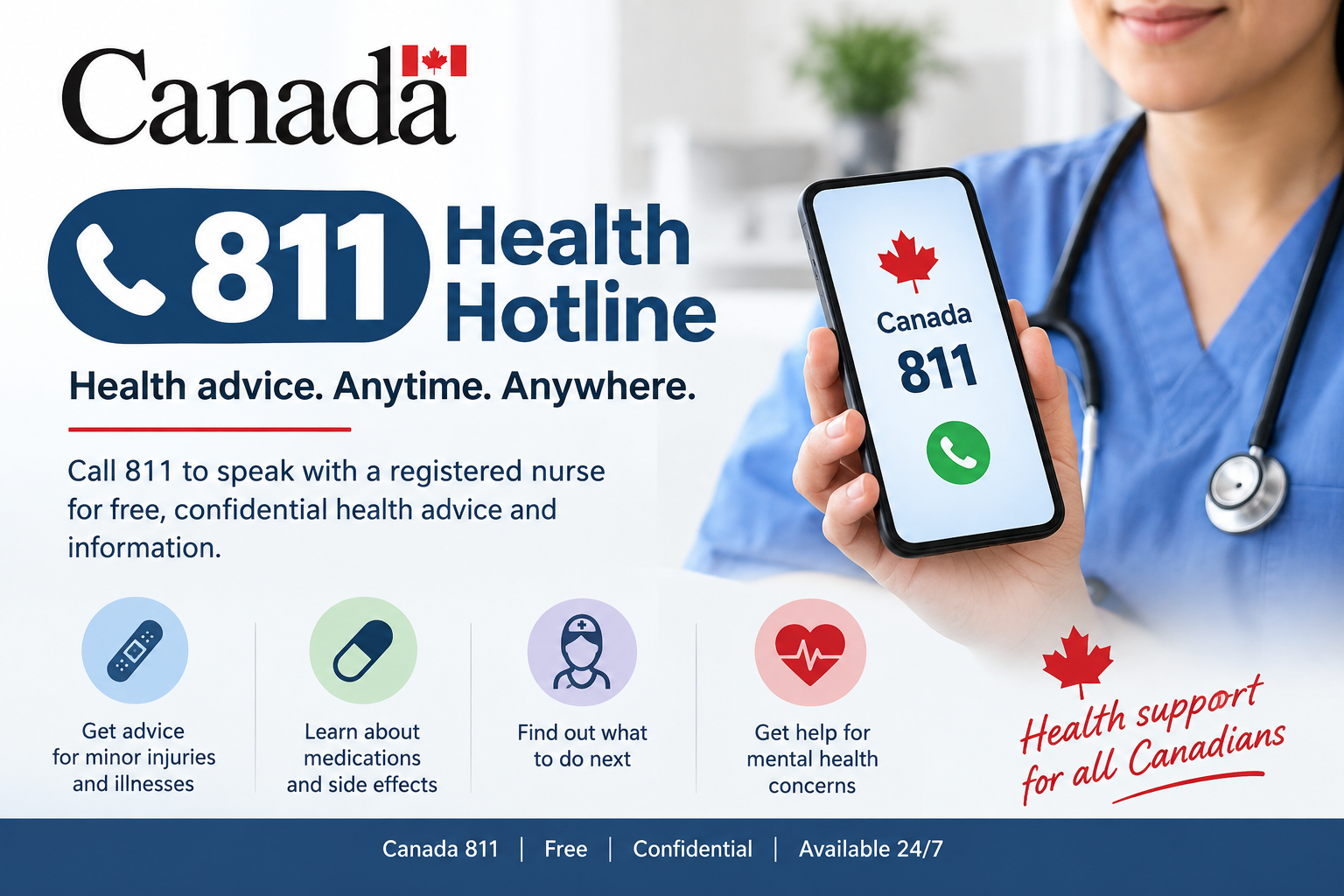
Knowing where to turn when you have a health concern can be difficult, especially when you are unsure whether your symptoms require a doctor’s appointment, a walk-in clinic, or emergency care. This is where the Canada 811 health hotline can be useful.
The 811 service provides access to non-emergency health information and care navigation. Depending on where you live, you may speak with a registered nurse, health navigator, pharmacist, dietitian, or another qualified professional.
However, 811 is not exactly the same across Canada. Health services are administered provincially and territorially, so the type of support, language services, and available options can differ.
This guide explains what Canada’s 811 health hotline does, when to call, what happens during a call, and how it differs from 911.
What Is the Canada 811 Health Hotline?
The Canada 811 health hotline is a telephone-based service designed to help people with non-emergency health questions and care decisions.
The 811 number was reserved in Canada for provincial health services, but each province or territory operates its own program. As a result, the service may have a different name and slightly different features depending on your location.
For example:
- British Columbia provides HealthLink BC 8-1-1.
- Quebec provides Info-Santé 811.
- New Brunswick provides Tele-Care 811.
- Nova Scotia provides health information through 811.
- Saskatchewan operates HealthLine 811.
- Some jurisdictions provide 811 services with different arrangements or additional access numbers.
The main purpose is to help people determine what type of health support they may need without automatically going to an emergency department.
How Does 811 Work in Canada?
When you call 811, the process generally begins with questions about your health concern.
Depending on your province and the nature of your problem, the person assisting you may:
- Ask about your symptoms.
- Determine how urgent your situation may be.
- Provide general health information.
- Give self-care advice when appropriate.
- Recommend contacting a doctor or other healthcare provider.
- Direct you to a clinic, pharmacy, or other community service.
- Recommend urgent or emergency medical care when necessary.
For example, New Brunswick’s Tele-Care 811 allows callers to discuss symptoms with registered nurses and receive guidance about self-care, clinics, community services, or emergency care.
In British Columbia, HealthLink BC 811 can connect callers with health service navigators and, depending on their needs, registered nurses, registered dietitians, pharmacists, and other professionals.
What Can You Call 811 About?
The exact services vary by location, but 811 can generally help with non-emergency health concerns.
You may call about:
- Cold or flu symptoms
- Fever
- Minor injuries
- Questions about symptoms
- Medication-related questions
- General health information
- Finding healthcare services
- Questions about where to receive care
- Deciding whether you need a clinic or other healthcare service
- Some child health concerns
- Self-care guidance
For instance, Quebec’s Info-Santé 811 allows residents to speak with a nurse about non-urgent health concerns and receive advice about home care or appropriate healthcare resources.
Can 811 Help With Children’s Health?
In some provinces, yes.
Quebec’s 811 service includes a pediatric option for children from birth through age 17. A nurse can assess the child’s situation and provide advice or direct the family to an appropriate healthcare service.
The availability and process for children’s health advice can differ elsewhere in Canada.
What Happens When You Call 811?
A typical 811 call involves a short assessment of your health concern.
You may be asked:
- What symptoms you have
- When the symptoms started
- How severe they are
- Whether your condition is getting better or worse
- Your age or the age of the person needing help
- Relevant medical information
The health professional then uses this information to provide appropriate guidance.
For example, New Brunswick says callers can speak with a registered nurse, who asks questions about symptoms and assesses the situation before recommending appropriate next steps.
In Quebec, an Info-Santé nurse assesses the situation, responds to the person’s needs, and can refer the caller to an appropriate resource if necessary.
811 Health Services by Province
Because Canada’s healthcare system is largely administered by provinces and territories, 811 does not provide exactly the same service everywhere.
| Province/Territory | 811 Health Service |
|---|---|
| British Columbia | HealthLink BC |
| Alberta | Health Link |
| Saskatchewan | HealthLine |
| Manitoba | Health Links–Info Santé |
| Ontario | Health811 |
| New Brunswick | Tele-Care 811 |
| Nova Scotia | 811 |
| Prince Edward Island | 811 |
| Newfoundland and Labrador | 811 |
| Quebec | Info-Santé 811 |
| Yukon | 811 |
| Northwest Territories | 811 |
| Nunavut | Local health services may apply |
The Government of Canada lists 811 health contacts across many provinces and territories, while individual provincial services provide more detailed information about how their programs operate.
One important exception is Manitoba, where Health Links–Info Santé currently uses dedicated telephone numbers rather than simply dialing 811. The Manitoba government says the service is available 24/7 and staffed by nurses.
British Columbia
HealthLink BC provides 8-1-1 access to health service navigators 24 hours a day, seven days a week. Callers can also be connected to healthcare professionals, and translation services are available in more than 130 languages.
Quebec
Info-Santé 811 is a free and confidential service for non-urgent health concerns. It is available 24 hours a day, 365 days a year in most regions of Quebec.
New Brunswick
Tele-Care 811 is a free, confidential and bilingual provincial health line. It is available day and night and can help callers assess health concerns and find appropriate services.
Nova Scotia
Nova Scotia’s 811 service provides non-emergency health information and allows residents to speak with registered nurses about general health questions. Language interpretation is also available.
811 vs. 911: What’s the Difference?
One of the most important things to understand is that 811 and 911 serve different purposes.
| 811 | 911 |
|---|---|
| Non-emergency health concerns | Emergencies |
| Health advice and information | Emergency response |
| Symptom assessment | Immediate emergency assistance |
| Care navigation | Police, fire, ambulance and emergency services |
| Helps determine appropriate care | Used when immediate danger exists |
If you have a serious or life-threatening emergency, do not wait for 811 advice. Call 911 or go to the nearest emergency department.
HealthLink BC specifically advises people to call 9-1-1 for emergencies, while Quebec’s government gives the same instruction for serious or urgent problems.
Who Can Use the 811 Health Hotline?
Eligibility depends on the provincial service, but 811 health lines are generally intended for residents of the province or territory providing the service.
For example, Quebec states that residents can call Info-Santé 811 for themselves or a family member. New Brunswick describes Tele-Care 811 as a provincial service available to New Brunswickers.
If you are travelling or calling from outside your province, the normal 811 number may not work in the same way. Check your local health authority for the correct contact method.
Benefits of Calling 811
The 811 service can be useful when you are uncertain about what to do next.
1. Convenient access to health information
You can receive health guidance by phone instead of immediately travelling to a healthcare facility.
2. Help deciding where to seek care
A health professional can help you understand whether you may need self-care, a clinic, a doctor, or another service.
3. Available outside regular office hours
Several provincial 811 services operate 24 hours a day, including British Columbia, Quebec and New Brunswick.
4. Language support
Some 811 services provide interpretation or multilingual assistance. For example, HealthLink BC reports translation support in more than 130 languages.
5. Care navigation
811 can help people find appropriate healthcare services in their community rather than trying to determine the right destination on their own.
What Information Should You Have Ready?
Before calling, it can help to have:
- Your symptoms
- When they started
- Any changes in your symptoms
- Current medications, if relevant
- Your age
- Your location or postal code
- Relevant medical information
- Questions you want answered
You do not need to diagnose yourself before calling. Simply explain what you are experiencing as clearly as possible.
When Should You Not Call 811?
811 is intended for non-emergency health concerns. It should not replace emergency services.
Call 911 immediately when there is an immediate threat to life, such as:
- Severe difficulty breathing
- Loss of consciousness
- A life-threatening injury
- Serious poisoning
- Another condition that appears to require immediate emergency assistance
The exact emergency criteria can vary, but Canadian provincial health authorities consistently distinguish emergency care from non-emergency 811 advice.
FAQs
1. What is the Canada 811 health hotline?
The Canada 811 health hotline is a non-emergency health information and care-navigation service used by many Canadian provinces and territories. Depending on where you live, you may speak with a nurse or another qualified health professional.
2. Is calling 811 free in Canada?
Many provincial 811 services are free. For example, Quebec’s Info-Santé 811 and New Brunswick’s Tele-Care 811 are described by their governments as free services.
3. Can I call 811 instead of going to the emergency room?
811 can help you determine what type of care may be appropriate for a non-emergency health concern. However, if you are experiencing a medical emergency, call 911 instead of waiting for 811 advice.
4. Can I speak to a nurse when I call 811?
In many provinces, yes. For example, Quebec’s Info-Santé 811 and New Brunswick’s Tele-Care 811 provide access to nurses for health assessments and advice.
5. Is 811 available 24 hours a day?
Many provincial 811 services operate 24/7, but availability and services vary by location. British Columbia, Quebec and New Brunswick, for example, describe their services as available around the clock.
6. Can 811 help me find a doctor or healthcare service?
In many jurisdictions, 811 can help you navigate available healthcare services. The exact services depend on your province or territory.
7. Is 811 the same everywhere in Canada?
No. Canada’s provinces and territories administer their healthcare services separately, so the name, telephone process, available professionals and additional services can differ.
Conclusion
The Canada 811 health hotline provides an important way to get help with non-emergency health concerns without immediately visiting an emergency department. Depending on your province, you may receive symptom guidance, speak with a registered nurse, get self-care information, or be directed toward an appropriate healthcare service.
The key point is to understand what 811 is designed for: non-emergency health advice and care navigation. Because services vary across Canada, residents should use their provincial or territorial health authority for the most current information.
For a serious or life-threatening emergency, call 911 immediately rather than relying on 811.
Learn About: Online Doctor Appointments
