
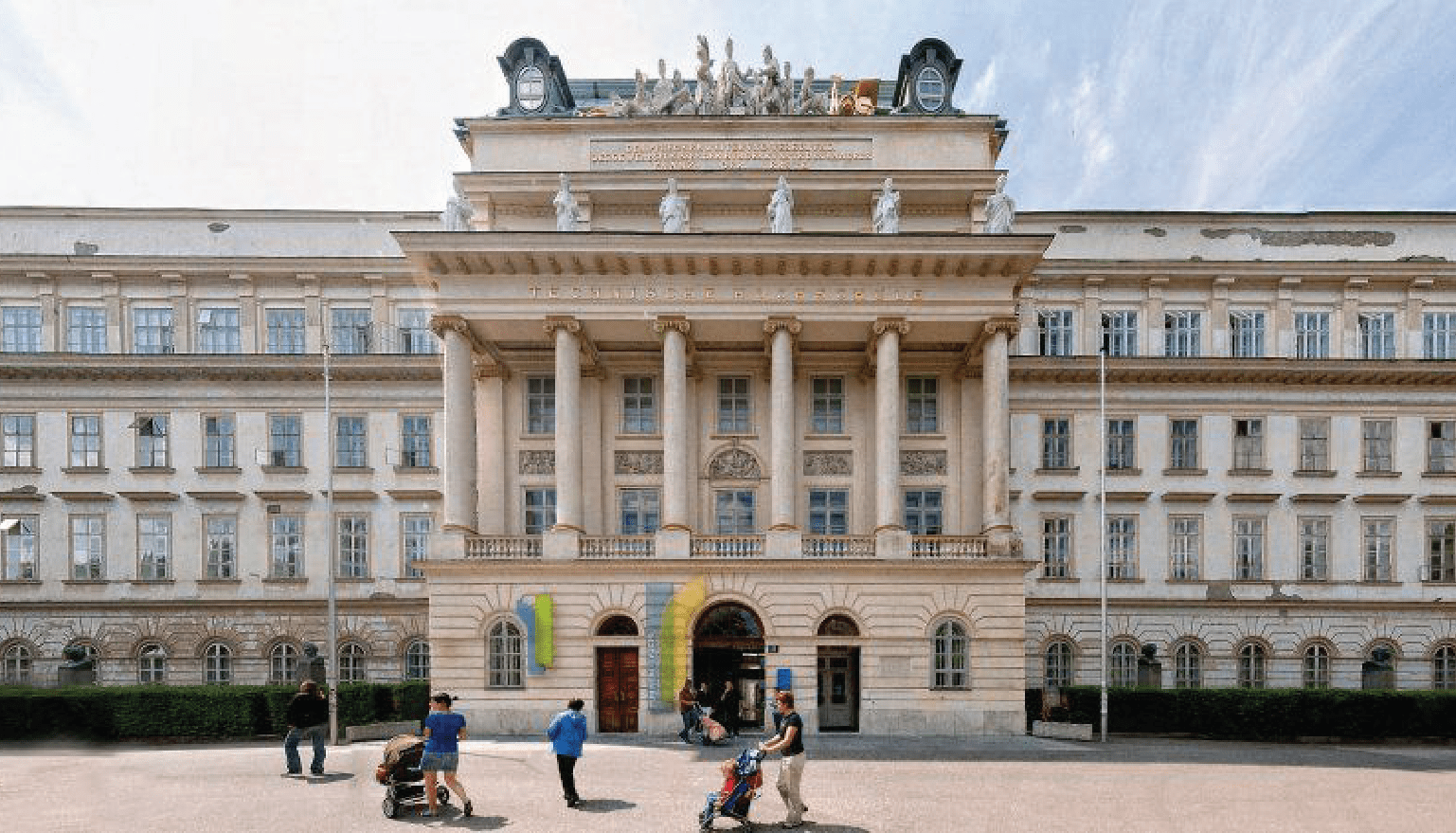
Vienna University of Technology, officially known as TU Wien, is a major technical university in Vienna, Austria. Founded in 1815, it offers bachelor’s, master’s, and doctoral programs across engineering, computer science, architecture, mathematics, physics, chemistry, and related fields. TU Wien combines research-led teaching with a strong international focus and is located in the center of Vienna.
What Is Vienna University of Technology?
Vienna University of Technology, commonly called TU Wien, is a technology-focused university in the heart of Vienna, Austria. It has a strong academic profile in engineering, natural sciences, computer science, architecture, and other technical disciplines.
The university brings together education and research, giving students opportunities to study established technical subjects while also engaging with emerging areas of science and technology. TU Wien currently has more than 27,000 active students and more than 6,000 employees, according to its latest published figures.
Its central location also gives students access to Vienna’s cultural, professional, and research environment.
History and Development of TU Wien
The roots of the Vienna University of Technology go back to 1815, when the institution was founded as the k. k. Polytechnic Institut in Vienna. Its creation reflected the growing need for technically and scientifically trained professionals during a period of industrial and economic development.
Over more than two centuries, the institution developed from a traditional polytechnic school into a comprehensive technical university with a broad research and teaching portfolio.
Today, TU Wien combines its long academic tradition with modern research infrastructure, international cooperation, and programs designed around current scientific and technological challenges.
Academic Programs and Faculties
TU Wien offers programs across several major technical and scientific areas. Its faculties include:
- Architecture and Planning
- Civil and Environmental Engineering
- Electrical Engineering and Information Technology
- Informatics
- Mechanical and Industrial Engineering
- Mathematics and Geoinformation
- Physics
- Technical Chemistry
This structure allows students to pursue both specialized technical education and interdisciplinary areas of study.
For students interested in technology, engineering, computing, architecture, or the natural sciences, the university provides a wide selection of academic paths.
Bachelor’s Programs at Vienna University of Technology
Bachelor’s programs at TU Wien generally last six semesters and lead to a Bachelor of Science degree. Most bachelor’s programs are taught in German, so prospective international students should carefully check the language requirements for their chosen program.
Available areas include subjects such as:
- Architecture
- Informatics and Business Informatics
- Spatial Planning
- Civil Engineering
- Electrical Engineering
Some bachelor’s programs have limited places and require an entrance examination or another admission procedure. Computer Science, Architecture, and Spatial Planning are among the programs with entrance examination procedures.
Master’s Programs and International Study Options
Master’s study at TU Wien offers greater specialization and includes both German- and English-taught options.
The university currently lists 19 English-taught, 13 German-taught, and 8 interuniversity master’s programs. Its subject range extends from established engineering disciplines to interdisciplinary and future-oriented fields.
This makes the university particularly interesting for international students who want to complete an advanced technical degree in English.
New master’s programs are also being introduced. For the 2026/27 winter semester, TU Wien lists Aeronautical Engineering and Medical Informatics among its new programs.
Research at TU Wien
Research is a central part of the university’s identity. TU Wien describes its research as covering the path from basic research to practical applications.
Its eight faculties include around 50 institutes and approximately 4,000 researchers, working across engineering and natural science disciplines. Research is organized around key areas while also encouraging interdisciplinary cooperation.
Students can benefit from this research environment through research-led teaching and opportunities connected with academic projects. TU Wien also emphasizes the importance of involving students in research programs as part of its educational approach.
Admission Requirements and Application Process
Admission requirements depend on the level and program selected. TU Wien provides separate procedures for bachelor’s, master’s, and doctoral applicants.
For bachelor’s applicants, the process can include pre-registration, an entrance examination for selected programs, submission of required documents, and final enrolment. International applicants may have additional requirements depending on their educational background and citizenship.
Master’s applicants generally need a relevant bachelor’s degree or equivalent qualification. Some master’s programs have selection procedures, while others do not.
Because deadlines vary by program, students should check the official academic calendar before preparing an application. For the 2026/27 winter semester, TU Wien lists different deadlines for bachelor’s and master’s programs.
Studying at TU Wien as an International Student
TU Wien has a substantial international community. The university states that more than one-third of its students come from outside Austria, creating a diverse academic environment.
International students should consider several factors before applying:
- Program language
- Previous educational qualifications
- Admission deadlines
- Entrance examinations, where applicable
- Required documents
- Tuition and student fees
- Residence and accommodation arrangements
- German-language requirements for relevant programs
For applicants coming from outside Austria, checking the university’s official admission information early can make the application process easier.
Campus and Location
TU Wien is located in central Vienna, with several campus areas across the city. Major locations include Karlsplatz, Freihaus, Getreidemarkt, Gußhaus, Atominstitut, and the Science Center.
The main address listed by TU Wien is Karlsplatz 13, 1040 Vienna. The university’s central location provides convenient access to public transportation and Vienna’s wider urban environment.
For students, being based in Vienna also means having access to museums, cultural institutions, businesses, research organizations, and an international professional environment.
Why Choose Vienna University of Technology?
There are several reasons students may consider TU Wien for technical and scientific education.
Strong Technical Focus
TU Wien is specifically oriented toward technology, engineering, computing, architecture, and natural sciences. This creates an academic environment centered on technical knowledge and innovation.
Research-Based Education
The connection between teaching and research allows students to learn in an environment where scientific investigation and practical applications are closely connected.
International Environment
With students and researchers from many countries, TU Wien provides an internationally diverse academic setting.
Central Vienna Location
The university’s campuses are integrated into Vienna rather than being isolated from the city. This gives students access to transportation, cultural activities, professional networks, and everyday city life.
Wide Range of Specializations
From informatics and electrical engineering to architecture, physics, mathematics, and technical chemistry, students can choose from a broad range of technical disciplines.
Frequently Asked Questions
Is Vienna University of Technology the same as TU Wien?
Yes. Vienna University of Technology is commonly known as TU Wien, which is the university’s official short name.
When was TU Wien founded?
TU Wien was founded in 1815 as the k. k. Polytechnic Institut in Vienna.
Where is Vienna University of Technology located?
TU Wien is located in Vienna, Austria, with several campus locations. Its main address is Karlsplatz 13, 1040 Vienna.
Does TU Wien offer programs in English?
Yes. TU Wien offers English-taught master’s programs. The university currently lists 19 English-taught master’s programs alongside German-taught and interuniversity options.
Are TU Wien bachelor’s programs taught in English?
Bachelor’s programs are generally taught in German. Students should check the language requirements for their specific program before applying.
Does TU Wien have entrance exams?
Some bachelor’s programs require entrance examinations, including Computer Science, Architecture, and Spatial Planning.
How many students study at TU Wien?
TU Wien reported 27,262 active students in the winter semester of 2025.
What fields can students study at TU Wien?
Students can study fields including architecture, engineering, informatics, mathematics, physics, technical chemistry, electrical engineering, and related disciplines.
Conclusion
Vienna University of Technology is a long-established technical university that combines more than two centuries of academic history with modern research and international education. Its programs cover a wide range of engineering, computing, architectural, mathematical, physical, and chemical disciplines.
For prospective students, the most important step is to identify a suitable program and then carefully review its language requirements, admission procedure, documents, and deadlines. With its research-focused environment and central Vienna location, TU Wien remains an important destination for students interested in technology and scientific education
Read More about: Die Berge Lifestyle
