
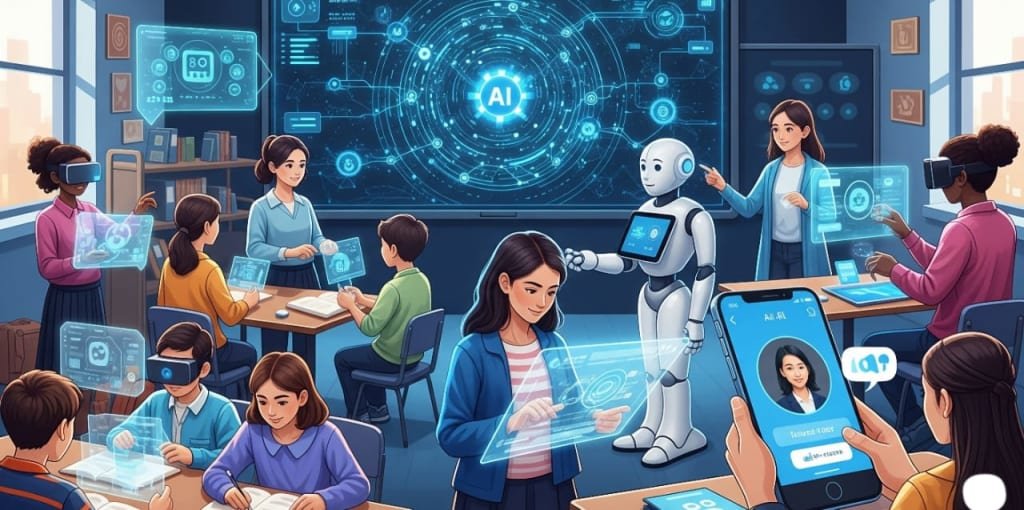
Artificial intelligence is becoming part of everyday life, from search engines and recommendation systems to chatbots, automated tools, and educational software. As AI becomes more common, knowing how to use it is no longer enough. Students, teachers, professionals, and organizations also need to understand how AI works, where it can help, and where its limitations matter.
The phrase teach AI can refer to two closely connected ideas: learning how to teach artificial intelligence and using AI tools to improve teaching. Both are becoming increasingly important in modern education.
Effective AI education should go beyond showing learners how to write prompts. It should develop critical thinking, digital literacy, technical understanding, creativity, and responsible decision-making. Teach AI, for example, focuses on helping educators teach with and about AI, while curriculum-focused platforms provide tools for lesson planning, assessment, differentiation, and classroom workflows.
What Does Teach AI Mean?
Teach AI generally means helping people understand artificial intelligence, its applications, its limitations, and its impact on society.
AI education can be designed for different levels. A beginner may only need to understand what AI and machine learning mean, while an advanced learner may study neural networks, natural language processing, computer vision, or model development.
There is also an important distinction between teaching AI and teaching with AI:
| Approach | Main Purpose |
| Teaching AI | Explain how artificial intelligence works |
| Teaching with AI | Use AI tools to support learning |
| AI literacy | Help learners evaluate and use AI responsibly |
| AI development | Teach people how to build AI systems |
A strong education program can combine all four.
Why Is AI Education Important?
AI is developing quickly, but many learners still encounter it mainly through consumer applications. That can create misconceptions about what AI actually does.
Good AI education helps learners understand that AI systems can be useful without being infallible. Current education guidance increasingly emphasizes AI literacy, privacy, security, academic integrity, equity, and responsible use.
1. AI is changing the workplace
Many industries are adopting AI for research, communication, data analysis, customer support, software development, and automation. Students who understand AI can make better decisions about how technology fits into their future careers.
2. AI can produce incorrect information
Generative AI can produce convincing but inaccurate answers. Students therefore need to learn how to verify claims rather than automatically trust generated content.
3. Responsible use matters
AI education should cover privacy, bias, copyright, transparency, academic integrity, and human oversight. These subjects are just as important as learning how to operate an AI tool.
What Should Students Learn About AI?
A practical AI curriculum does not need to begin with complicated mathematics. Start with concepts that learners can connect to everyday experiences.
Core AI concepts
Students can gradually learn:
- What artificial intelligence means
- How machine learning differs from traditional programming
- What training data is
- How algorithms identify patterns
- What generative AI does
- How chatbots and language models work at a high level
- Why AI sometimes produces errors
- How bias can enter AI systems
- How humans remain responsible for important decisions
For older or more advanced learners, lessons can introduce neural networks, computer vision, natural language processing, predictive models, and model evaluation.
How to Teach AI Step by Step
Step 1: Begin with familiar examples
Ask students where they encounter AI in daily life.
Examples include:
- Voice assistants
- Streaming recommendations
- Search engines
- Translation tools
- Fraud detection
- Chatbots
- Image-generation applications
This makes an unfamiliar subject easier to understand.
Step 2: Explain the basic idea
Use a simple example.
Suppose an AI system is trained to distinguish cats from dogs. It needs examples, patterns, and a method for learning from data. The model then uses what it has learned to make predictions about new images.
The goal is not to suggest that the computer “thinks” exactly like a human. Instead, students should understand that AI systems process information according to mathematical and computational methods.
Step 3: Introduce hands-on activities
Practical exercises make AI concepts easier to remember.
For example, students can:
- Compare human-written and AI-generated text.
- Identify factual errors in an AI response.
- Test how changing a prompt changes an output.
- Discuss whether an AI recommendation is fair.
- Create a simple classification activity using sample data.
Step 4: Teach verification
Make verification part of every AI activity.
Students should ask:
- Is the information accurate?
- What evidence supports the claim?
- Could the AI have misunderstood the question?
- Are important details missing?
- Should I check another reliable source?
This builds stronger digital literacy than simply teaching prompt-writing.
Using AI Tools in the Classroom
AI can support teachers with planning, differentiation, quizzes, worksheets, presentations, and feedback. Modern education platforms offer tools for curriculum-aligned lesson creation, assessments, revision activities, and personalized resources.
However, AI should support the teacher rather than replace professional judgment.
Examples of useful classroom applications
Lesson planning:
Teachers can use AI to brainstorm activities, structure lesson sequences, or create differentiated materials.
Assessment:
AI can help draft questions, quizzes, rubrics, and feedback that teachers review before use.
Personalized learning:
Teachers can adapt explanations or practice activities for different levels of understanding.
Revision:
Students can use AI to generate practice questions or explain difficult concepts, followed by independent verification.
TeachAI’s educator training resources similarly emphasize practical workflows, lesson planning, assessment, differentiation, quality assurance, and responsible AI use.
Responsible and Ethical AI Education
Teaching AI without discussing its risks leaves learners unprepared.
Privacy
Students should understand that they should not enter sensitive personal information into AI systems without appropriate authorization and safeguards.
Bias
AI models can reproduce or amplify patterns present in their training data. Learners should therefore understand that an AI output is not automatically neutral or fair.
Academic integrity
Schools need clear expectations about when AI assistance is allowed. Students should know the difference between using AI as a learning aid and submitting AI-generated work as their own when that violates academic rules.
Human oversight
Important educational decisions should involve appropriate human review. AI can assist with information and workflows, but responsibility should remain with qualified people.
TeachAI’s school guidance toolkit highlights benefits such as personalized learning and administrative efficiency while also identifying risks including bias, plagiarism, overreliance, and reduced critical thinking.
Practical AI Teaching Examples
Example 1: AI fact-checking lesson
Give students an AI-generated paragraph containing several factual claims. Ask them to research each claim and label it:
- Supported
- Incorrect
- Unclear
- Requires more evidence
This teaches both AI literacy and research skills.
Example 2: Prompt improvement exercise
Start with a vague prompt such as:
Explain climate change.
Then ask students to improve it by adding audience, topic boundaries, format, and desired depth.
The lesson demonstrates that better instructions can produce more useful results while still requiring human evaluation.
Example 3: AI ethics discussion
Present a scenario where an organization wants to use AI to evaluate applications. Students can discuss possible benefits, risks, bias, privacy concerns, and the role of human review.
These activities encourage students to think about AI rather than simply consume it.
Benefits and Challenges of Teaching AI
Benefits
- Builds future-ready digital skills
- Encourages critical thinking
- Improves technological confidence
- Supports personalized learning
- Helps students understand AI limitations
- Prepares learners for changing workplaces
Challenges
- AI technology changes rapidly
- Teachers may need professional development
- AI outputs can contain errors
- Privacy and data protection require attention
- Access to technology can vary between schools
- Policies around academic integrity must be clear
The best approach is therefore not to chase every new AI tool. Instead, schools can focus on durable concepts and skills that remain useful as individual applications change.
Key Takeaways
- Teach AI should include both AI knowledge and responsible practical use.
- Students need to understand AI’s capabilities and limitations.
- AI literacy involves verification, critical thinking, ethics, and privacy.
- Teachers can use AI for planning, assessment, differentiation, and learning activities.
- AI-generated information should be reviewed before important decisions are made.
- Practical projects often make AI concepts easier to understand.
- Strong school policies should address responsible use and academic integrity.
- Human judgment remains essential when using AI in education.
FAQs
1. What does teach AI mean?
Teach AI means educating people about artificial intelligence, including how AI works, where it is used, what its limitations are, and how to use it responsibly. It can also refer to using AI technology to support teaching and learning.
2. How can beginners learn to teach AI?
Beginners can start with basic AI concepts, everyday examples, simple classroom activities, and responsible-use principles. Technical programming can be introduced later depending on the learner’s age and goals.
3. Can AI replace teachers?
AI can automate or assist with some educational tasks, but it does not replace the broader role of teachers. Teaching involves judgment, relationships, motivation, classroom management, context, and understanding individual learners.
4. What is AI literacy?
AI literacy is the ability to understand, evaluate, use, and discuss artificial intelligence effectively and responsibly. It includes recognizing AI limitations, checking information, understanding ethical concerns, and making informed decisions.
5. Is AI useful for lesson planning?
Yes. AI can help teachers brainstorm lesson structures, activities, questions, worksheets, and differentiated resources. Teachers should review generated materials for accuracy, curriculum alignment, suitability, and learning objectives.
6. Should students be allowed to use AI for assignments?
It depends on the assignment and the school’s policy. Educators should clearly explain when AI is permitted, what type of assistance is acceptable, and when students must complete work independently.
7. What is the best age to start teaching AI?
There is no single starting age. Younger students can learn simple concepts such as patterns, instructions, and responsible technology use, while older students can study machine learning, generative AI, ethics, and technical development in greater depth.
Conclusion
Learning to teach AI is becoming an important part of modern education. The strongest approach is not simply showing students how to use the latest chatbot or AI application. It is about developing lasting skills: understanding how AI works, questioning its outputs, protecting personal information, recognizing potential bias, and using technology with purpose.
For educators, AI can reduce time spent on routine tasks and support lesson planning, assessment, differentiation, and personalized learning. For students, AI education can build the confidence and critical thinking needed to navigate an increasingly technology-driven world.
Learn About: Merfez
