
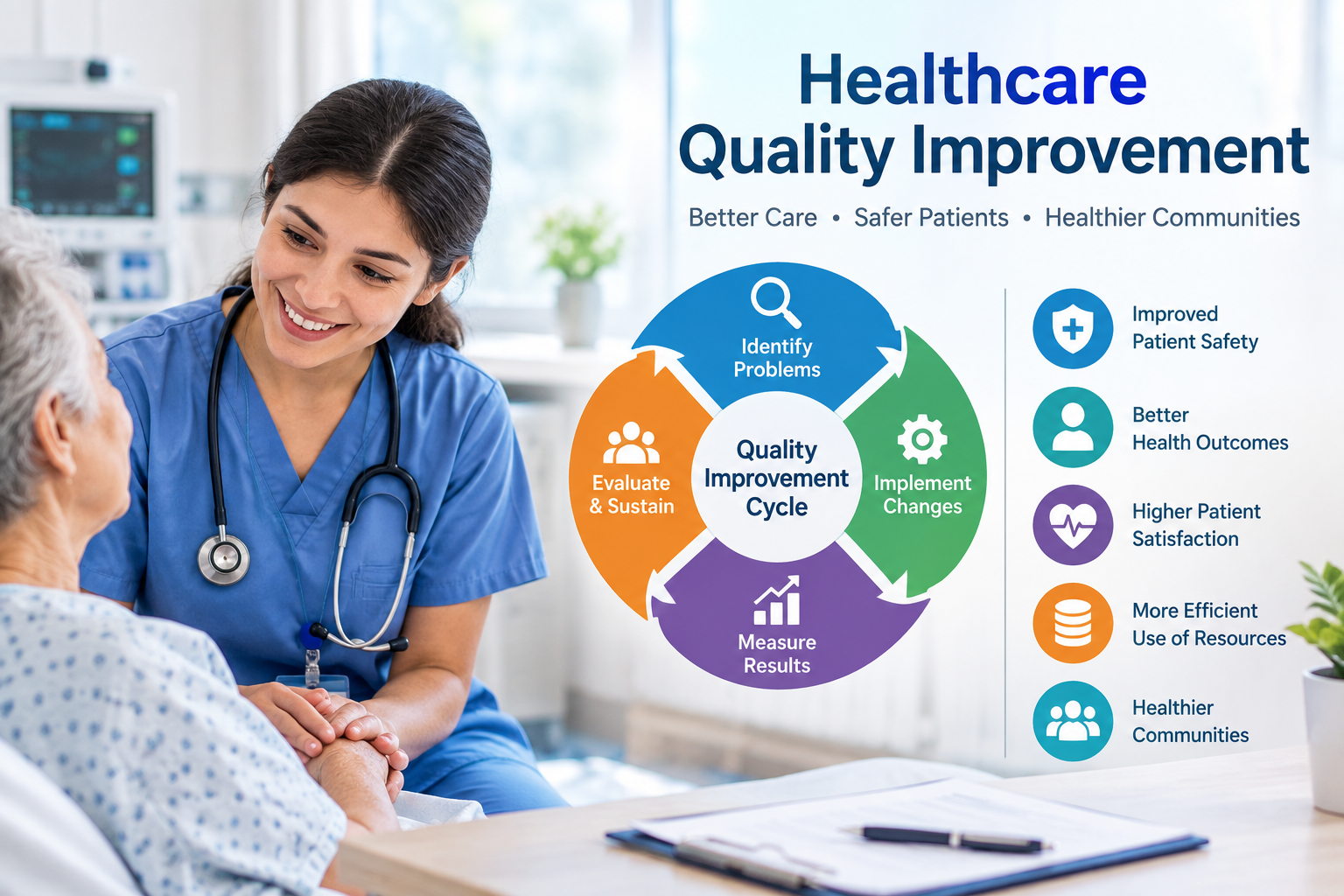
Healthcare organizations constantly look for ways to provide safer, more effective, accessible, and patient-centered care. Even when clinical teams follow established standards, problems such as medication errors, long waiting times, hospital-acquired infections, communication gaps, and inefficient processes can still occur.
Healthcare quality improvement provides a structured way to identify these problems and make measurable improvements. Rather than relying on assumptions, quality improvement uses data, teamwork, evidence, and continuous testing to determine what works.
For hospitals, clinics, medical practices, and other healthcare organizations, QI can improve both clinical outcomes and everyday operational processes. It can also help healthcare professionals understand where care is falling short and develop practical solutions.
What Is Healthcare Quality Improvement?
Healthcare quality improvement is a continuous, systematic process designed to make healthcare services safer, more effective, efficient, equitable, timely, and patient-centered.
The goal is not simply to identify mistakes. Instead, quality improvement focuses on understanding why a problem occurs, testing possible solutions, measuring results, and making successful changes part of routine practice.
For example, if a clinic discovers that patients regularly wait more than an hour for appointments, a QI team may examine scheduling patterns, staffing, patient flow, and registration procedures. The team can then test a new scheduling process and measure whether waiting times decrease.
Quality Improvement vs. Quality Assurance
Although the terms are related, they are not identical.
- Quality assurance generally focuses on maintaining established standards and identifying whether requirements are being met.
- Quality improvement focuses on continuously improving processes and outcomes.
- Quality control commonly involves monitoring performance to identify deviations from expected standards.
Together, these approaches can support safer and more reliable healthcare delivery.
Why Is Quality Improvement Important in Healthcare?
Healthcare quality improvement matters because even small process problems can affect patient outcomes, staff workload, costs, and patient satisfaction.
Effective QI programs can help organizations:
- Reduce preventable errors
- Improve patient safety
- Strengthen clinical outcomes
- Reduce unnecessary delays
- Improve communication between healthcare professionals
- Make better use of staff and resources
- Improve patient experience
- Reduce avoidable healthcare costs
- Standardize effective processes
- Support evidence-based decision-making
Quality improvement can also benefit healthcare professionals. When inefficient processes are improved, staff may spend less time dealing with unnecessary administrative problems and more time focusing on patient care.
Key Principles of Healthcare Quality Improvement
Successful QI programs usually share several important principles.
1. Patient-Centered Care
Patients should remain at the center of improvement efforts. Their experiences, preferences, needs, and outcomes can provide valuable information about what needs to change.
2. Data-Driven Decisions
Healthcare organizations should use reliable data to understand current performance and evaluate whether an intervention actually works.
Useful measures may include:
- Readmission rates
- Infection rates
- Medication errors
- Patient waiting times
- Patient satisfaction
- Length of stay
- Appointment cancellations
- Treatment adherence
3. Teamwork
Quality improvement is rarely the responsibility of one person. Physicians, nurses, pharmacists, administrators, technicians, patients, and other stakeholders may all contribute valuable perspectives.
4. Continuous Improvement
QI is not normally a one-time project. Healthcare organizations should continue monitoring performance and adjusting processes when new problems or opportunities emerge.
5. Evidence-Based Practice
Improvement strategies should be informed by reliable clinical evidence, professional standards, organizational data, and lessons from previous improvement projects.
Common Healthcare Quality Improvement Methods
Healthcare organizations use several established approaches to improve quality.
Plan-Do-Study-Act (PDSA)
The PDSA cycle is widely used for testing changes on a small scale.
- Plan: Identify a problem and decide what change to test.
- Do: Implement the change on a limited scale.
- Study: Review the results and compare them with expectations.
- Act: Adopt, modify, or abandon the change based on what was learned.
For example, a hospital might test a new medication reconciliation checklist in one department before considering broader implementation.
Lean Healthcare
Lean principles focus on reducing unnecessary steps, delays, duplication, and other forms of waste while improving value for patients.
A clinic might use Lean methods to redesign patient flow so patients spend less time moving between registration, consultation, and diagnostic services.
Six Sigma
Six Sigma uses structured methods and data analysis to reduce variation and defects in processes. It can be useful when healthcare organizations need to improve consistency and identify the causes of recurring problems.
Root Cause Analysis
Root cause analysis examines why an adverse event or process failure occurred. Instead of simply asking who made a mistake, the team examines contributing factors such as communication, staffing, training, workflow, technology, or policies.
The Quality Improvement Process
A healthcare quality improvement project can follow a structured sequence.
Step 1: Identify the Problem
Start with a clearly defined problem rather than a general goal.
Instead of saying, “We need better patient care,” a team could identify a specific issue such as:
“Patients in the outpatient department are experiencing long appointment delays.”
Step 2: Establish a Baseline
Measure the current situation before introducing a solution. This provides a comparison point for future results.
Step 3: Identify Possible Causes
Use staff feedback, patient feedback, process mapping, audits, and available data to understand what may be contributing to the problem.
Step 4: Develop and Test a Change
Choose a realistic intervention and test it. Small-scale testing can help organizations identify unexpected problems before making larger changes.
Step 5: Measure the Results
Compare performance before and after the intervention.
A useful QI measurement framework can include:
| Measure | What It Shows |
|---|---|
| Outcome measure | Whether patient outcomes improved |
| Process measure | Whether the desired process was followed |
| Balancing measure | Whether the change created unintended problems |
| Patient experience measure | How patients experienced the change |
Step 6: Sustain Successful Improvements
If a change produces meaningful improvement, the organization can incorporate it into routine procedures, training, documentation, and monitoring.
Examples of Healthcare Quality Improvement
Healthcare quality improvement can address clinical, operational, and patient-experience problems.
Reducing Medication Errors
A healthcare organization may introduce medication reconciliation procedures, barcode scanning, staff education, or standardized documentation to reduce medication-related errors.
Preventing Healthcare-Associated Infections
A facility can monitor infection rates and improve practices such as hand hygiene, environmental cleaning, equipment handling, and infection-control procedures.
Improving Patient Waiting Times
A clinic may analyze appointment schedules and patient flow to identify bottlenecks. Adjusting appointment intervals or registration processes may reduce unnecessary delays.
Improving Hospital Discharge
Hospitals can examine discharge planning to identify communication gaps, medication misunderstandings, or delays in follow-up arrangements. A standardized discharge process may help patients transition more safely to the next stage of care.
Improving Patient Communication
Organizations can use patient feedback and staff training to improve communication, health education, appointment instructions, and information provided during transitions of care.
Measuring Quality Improvement in Healthcare
Measurement is essential because an intervention that sounds effective may not actually improve outcomes.
A QI team should define clear indicators before beginning a project.
For example, if the goal is to reduce outpatient waiting times, the organization could measure:
- Average waiting time
- Percentage of patients waiting longer than a defined threshold
- Appointment completion rates
- Patient satisfaction
- Staff workload
It is also important to monitor for unintended consequences. A process that reduces waiting time but increases errors would not represent a successful overall improvement.
Challenges in Healthcare Quality Improvement
Quality improvement can produce significant benefits, but implementation is not always easy.
Common challenges include:
- Limited staffing or financial resources
- Resistance to changing established routines
- Incomplete or unreliable data
- Poor communication between departments
- Lack of leadership support
- Competing organizational priorities
- Difficulty maintaining improvements over time
- Staff burnout and workload pressures
Successful QI programs address these barriers by involving staff early, communicating the purpose of the project clearly, using practical interventions, and providing ongoing feedback.
How Healthcare Organizations Can Build a QI Culture
A strong quality improvement culture makes improvement part of everyday healthcare rather than treating it as a separate project.
Organizations can support this culture by:
- Providing leadership support for improvement initiatives.
- Encouraging staff participation at different levels of the organization.
- Using transparent data to track progress.
- Recognizing successful improvements and sharing lessons learned.
- Listening to patients and families when designing changes.
- Creating psychological safety so staff can report problems without fear of inappropriate blame.
- Integrating successful changes into standard workflows and training.
A sustainable QI culture focuses on improving systems and processes while maintaining accountability for safe professional practice.
FAQs
1. What is an example of quality improvement in healthcare?
Reducing patient waiting times is one example. A clinic can analyze its workflow, identify delays, test a new scheduling process, and measure whether waiting times improve without negatively affecting patient care.
2. What are the main goals of healthcare quality improvement?
The main goals include improving patient safety, clinical outcomes, efficiency, timeliness, patient-centered care, and the overall quality of healthcare services.
3. What are the four steps of PDSA?
PDSA stands for Plan, Do, Study, and Act. Teams plan a change, test it, study the results, and then decide whether to adopt, modify, or abandon the intervention.
4. Why is data important in quality improvement?
Data establishes a baseline, identifies problems, tracks performance, and helps teams determine whether a change produced meaningful improvement.
5. Who is responsible for healthcare quality improvement?
QI is a shared responsibility. Healthcare professionals, administrators, managers, patients, and other stakeholders can contribute to identifying problems and developing effective solutions.
6. How does quality improvement improve patient safety?
QI can identify weaknesses in healthcare processes and introduce safer procedures, better communication, standardized workflows, monitoring systems, and other interventions designed to reduce preventable harm.
7. What is the difference between quality improvement and quality assurance?
Quality assurance generally focuses on maintaining compliance with established standards, while quality improvement focuses on continuously testing and implementing changes to achieve better performance and outcomes.
Conclusion
Healthcare quality improvement is an ongoing process that helps organizations turn problems into opportunities for better care. By combining patient-centered thinking, reliable data, teamwork, evidence-based approaches, and continuous measurement, healthcare teams can make meaningful improvements to safety, outcomes, efficiency, and patient experience.
The most effective QI efforts are not simply about introducing new policies. They involve understanding how healthcare systems actually work, testing practical changes, learning from results, and sustaining improvements that deliver measurable value for patients and healthcare professionals.
Learn About: Get Healthy
