
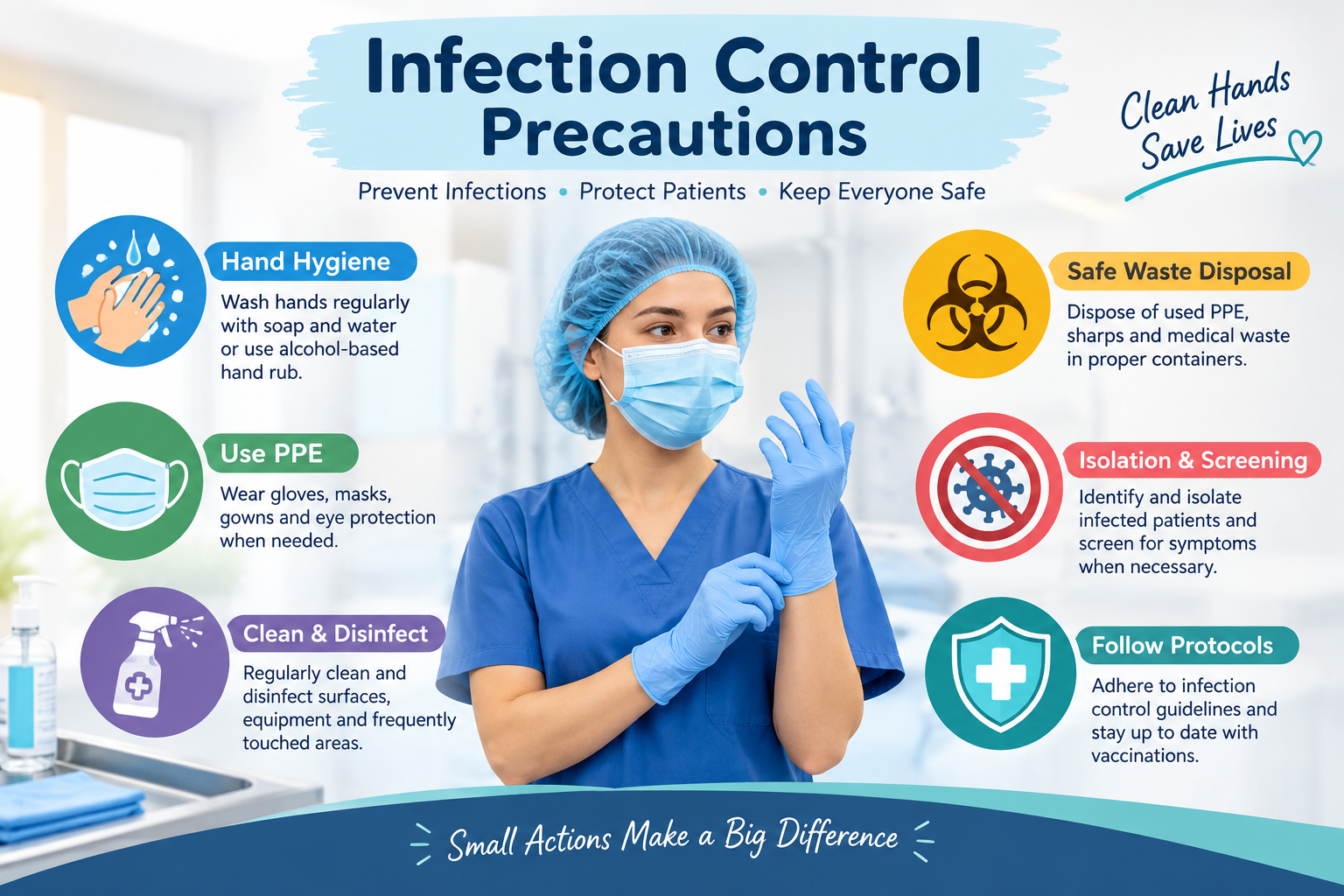
Infections can spread quickly in hospitals, clinics, nursing homes, laboratories, and other healthcare environments. Patients may already have weakened immune systems, while healthcare workers regularly come into contact with blood, body fluids, respiratory secretions, and contaminated surfaces.
Infection control precautions provide a structured way to reduce these risks. They help healthcare professionals decide what protective measures are needed during patient care and when additional precautions should be used.
Understanding these precautions is important for nurses, doctors, healthcare assistants, students, patients, and visitors. Good infection prevention practices can reduce healthcare-associated infections and protect both patients and healthcare workers.
What Are Infection Control Precautions?
Infection control precautions are practices designed to prevent or reduce the transmission of infectious microorganisms in healthcare and community settings.
They are based on how infections can spread through:
- Direct contact
- Indirect contact with contaminated objects
- Respiratory droplets
- Airborne particles
- Blood and body fluids
- Contaminated equipment or surfaces
Healthcare professionals use these precautions alongside appropriate clinical assessment and facility-specific infection prevention policies.
Why Are Infection Control Precautions Important?
Effective infection prevention protects several groups at the same time.
1. Protecting Patients
Patients can be particularly vulnerable to infection after surgery, during hospitalization, or when their immune defenses are weakened.
2. Protecting Healthcare Workers
Nurses, physicians, technicians, cleaners, and other healthcare workers may be exposed to infectious materials during routine duties.
3. Preventing Healthcare-Associated Infections
Proper infection control can help reduce infections that develop during healthcare delivery.
4. Limiting Outbreaks
Following appropriate precautions can reduce opportunities for infectious organisms to spread between patients and staff.
Standard Precautions
Standard precautions are used for the care of all patients, regardless of whether an infection is known or suspected.
They are based on the principle that blood, certain body fluids, non-intact skin, and mucous membranes may contain infectious microorganisms.
Important standard precautions include:
| Precaution | Purpose |
|---|---|
| Hand hygiene | Removes or reduces microorganisms on hands |
| PPE | Protects skin, eyes, nose, and mouth from exposure |
| Respiratory hygiene | Reduces respiratory transmission |
| Safe injection practices | Prevents contamination and bloodborne infection |
| Sharps safety | Reduces needlestick injuries |
| Environmental cleaning | Reduces contamination of surfaces |
| Safe handling of equipment | Prevents cross-contamination |
| Proper waste handling | Limits exposure to infectious materials |
Standard precautions should be applied consistently rather than only when a patient is known to have an infection.
Transmission-Based Precautions
Transmission-based precautions are additional measures used when standard precautions alone are not sufficient.
The major categories are:
- Contact precautions
- Droplet precautions
- Airborne precautions
The appropriate approach depends on the suspected or confirmed infection and how it spreads.
Contact Precautions
Contact precautions are used when microorganisms can spread through direct contact with a patient or indirect contact with contaminated objects and surfaces.
Depending on the healthcare facility’s policy, healthcare workers may need gloves and gowns when entering the patient’s care area or when contact with the patient or contaminated materials is anticipated.
Examples of situations where contact precautions may be required include certain infections involving multidrug-resistant organisms or organisms that can persist on environmental surfaces.
Key Practices
- Perform hand hygiene before and after patient contact.
- Wear appropriate PPE based on anticipated exposure.
- Use dedicated equipment when possible.
- Clean and disinfect frequently touched surfaces.
- Follow facility procedures for patient transport.
Droplet Precautions
Droplet precautions are used for infections that can spread through respiratory droplets produced when an infected person coughs, sneezes, or talks.
Depending on the infection and local guidance, healthcare workers may need a medical or surgical mask during patient care.
Good respiratory hygiene is also important.
Key Practices
- Encourage patients to cover coughs and sneezes.
- Provide tissues and hand hygiene supplies when appropriate.
- Wear recommended respiratory protection.
- Maintain appropriate patient placement according to facility guidance.
- Clean shared equipment between uses.
Airborne Precautions
Airborne precautions are used for infections that can spread through infectious particles that remain suspended in the air.
These precautions can require specialized controls, such as an appropriate airborne infection isolation room and a fit-tested respirator for healthcare workers, depending on the infection and applicable guidance.
Key Practices
- Follow facility isolation procedures.
- Use the recommended respiratory protection.
- Keep appropriate doors and ventilation controls in place.
- Limit unnecessary patient movement.
- Follow transport procedures when movement is necessary.
Personal Protective Equipment
Personal protective equipment (PPE) helps reduce exposure to infectious materials.
Common PPE includes:
- Gloves
- Gowns
- Masks
- Respirators
- Eye protection
- Face shields
PPE should be selected according to the expected exposure rather than automatically using every available item.
For example, gloves may be appropriate when contact with blood or body fluids is anticipated, while eye protection can help protect mucous membranes from splashes.
Proper donning and doffing—putting PPE on and removing it safely—also matters because incorrect removal can cause contamination.
Hand Hygiene and Infection Prevention
Hand hygiene is one of the most important components of infection prevention.
Healthcare workers should perform hand hygiene at appropriate points during patient care, including before and after patient contact and after contact with potentially infectious materials.
Hand hygiene can involve:
- Alcohol-based hand sanitizer when appropriate
- Washing with soap and water when required
Hands should also be cleaned after removing gloves because gloves do not replace hand hygiene.
A Simple Example
A nurse caring for multiple patients should perform hand hygiene between patient-care activities according to recommended procedures, even when gloves are used.
Safe Handling of Sharps and Medical Waste
Needles, scalpels, and other sharp instruments can cause injuries and may expose workers to bloodborne pathogens.
Safe practices include:
- Handle sharps carefully.
- Never leave used sharps in inappropriate locations.
- Dispose of sharps immediately in an approved sharps container.
- Avoid unnecessary manipulation of used needles.
- Follow local procedures for contaminated waste.
Healthcare facilities should also provide appropriate training and disposal systems.
Infection Control Precautions in Different Settings
Infection prevention practices can vary depending on the environment.
Hospitals
Hospitals commonly use standard precautions alongside transmission-based precautions when indicated.
Clinics and Outpatient Centers
Clinics should emphasize hand hygiene, respiratory hygiene, environmental cleaning, appropriate PPE, and safe handling of medical equipment.
Nursing Homes and Long-Term Care
Residents may have multiple health conditions, making infection prevention especially important. Staff should follow facility protocols for isolation and outbreak management.
Dental Settings
Dental procedures can involve exposure to saliva, blood, respiratory secretions, and aerosols. Appropriate PPE, instrument sterilization, environmental cleaning, and hand hygiene are essential.
Common Infection Control Mistakes
Even basic precautions can become ineffective when they are applied inconsistently.
Common mistakes include:
- Skipping hand hygiene
- Using gloves as a substitute for hand washing
- Wearing contaminated PPE outside the appropriate care area
- Reusing equipment without proper cleaning
- Improper sharps disposal
- Touching clean surfaces with contaminated gloves
- Failing to follow isolation instructions
- Ignoring respiratory hygiene
- Incorrectly removing PPE
Regular training, monitoring, and clear facility procedures can help reduce these problems.
FAQs
1. What are the main infection control precautions?
The main precautions include standard precautions, contact precautions, droplet precautions, and airborne precautions. Standard precautions are used for all patients, while transmission-based precautions provide additional protection when specific transmission risks are present.
2. What are standard precautions in infection control?
Standard precautions are basic infection prevention measures applied during the care of all patients. They include hand hygiene, appropriate PPE, respiratory hygiene, safe injection practices, sharps safety, and proper handling of contaminated equipment and materials.
3. What are the three types of transmission-based precautions?
The three main types are contact, droplet, and airborne precautions. The appropriate category depends on how the suspected or confirmed infection is transmitted.
4. Why is hand hygiene important in infection control?
Hand hygiene helps remove or reduce microorganisms that can be transferred between patients, healthcare workers, equipment, and surfaces. It is a fundamental part of preventing healthcare-associated infections.
5. Does wearing gloves replace hand hygiene?
No. Gloves do not replace proper hand hygiene. Healthcare workers should perform hand hygiene at the appropriate times, including after removing gloves.
6. What PPE is used for infection control?
Depending on the exposure risk, PPE may include gloves, gowns, masks, respirators, eye protection, and face shields. The specific PPE required depends on the procedure and suspected mode of transmission.
7. What is the difference between droplet and airborne precautions?
Droplet precautions address infections spread primarily through respiratory droplets, while airborne precautions are used for infections capable of spreading through infectious particles that remain suspended in the air. The required controls and respiratory protection can therefore differ.
Conclusion
Infection control precautions are essential for protecting patients, healthcare workers, and communities from preventable transmission of infectious microorganisms. Standard precautions provide the foundation for safe patient care, while contact, droplet, and airborne precautions add protection when particular transmission risks are present.
Consistent hand hygiene, appropriate PPE use, respiratory hygiene, environmental cleaning, safe sharps handling, and proper equipment management all contribute to effective infection prevention.
Because recommendations can vary by infection, procedure, and healthcare setting, professionals should always follow current guidance from their healthcare facility and relevant public-health authorities.
Learn About: Canada 811 Health Hotline
