
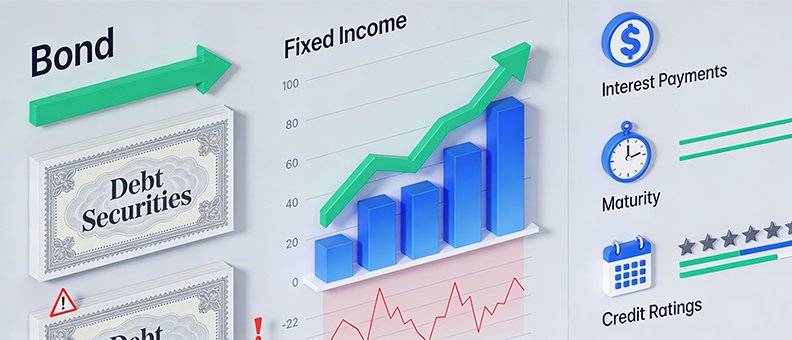
Debt securities are financial instruments that allow governments, companies, financial institutions, and other organizations to raise money by borrowing from investors. When an investor purchases a debt security, they are effectively lending money to the issuer under agreed terms.
The issuer generally agrees to repay the borrowed amount, known as the principal or face value, at a specified maturity date. Depending on the type of security, the investor may also receive interest payments throughout the investment period.
Common examples of debt securities include bonds, notes, Treasury securities, certificates of deposit, and commercial paper.
Debt securities play an important role in financial markets because they give organizations access to capital while providing investors with opportunities to earn income from lending their money.
How Debt Securities Work
The basic structure of a debt security is relatively straightforward. An organization that needs funding can issue debt securities to investors rather than relying entirely on traditional bank financing.
For example, suppose a company wants to raise $1 million to finance an expansion project. It could issue bonds to investors. The investors purchase those bonds, providing the company with the required capital.
In return, the company may agree to:
- Pay interest at a specified rate
- Make payments according to an agreed schedule
- Repay the principal at maturity
- Follow the terms and conditions established when the securities were issued
For instance, a company might issue a five-year bond with a face value of $1,000 and a fixed annual interest rate. An investor who purchases the bond may receive periodic interest payments and, assuming the issuer meets its obligations, receive the $1,000 principal when the bond reaches maturity.
Debt securities can also be bought and sold in secondary markets. This means investors do not necessarily have to hold them until maturity. Their market prices can change after issuance because of factors such as interest rates, credit conditions, investor demand, and economic conditions.
Common Types of Debt Securities
Debt securities come in several forms, and each type has different characteristics, terms, and potential risks.
Bonds
Bonds are among the most widely recognized types of debt securities. They can be issued by governments, corporations, municipalities, and other organizations to raise funds.
Corporate bonds are issued by companies, while government bonds are issued by national or local governments. Bonds can have fixed or variable interest rates and may have short-, medium-, or long-term maturities.
Treasury Securities
Treasury securities are issued by governments to help finance public spending and other government activities. In the United States, common examples include Treasury bills, Treasury notes, and Treasury bonds.
Treasury bills generally have shorter maturities, while Treasury notes and bonds are designed for longer periods. Their specific terms depend on the security being issued.
Corporate Debt Securities
Companies can issue different types of debt securities to raise capital. Corporate bonds and notes are common examples.
The interest rate offered by a company may depend partly on its creditworthiness, the maturity of the security, and other terms. Debt issued by an organization with greater perceived credit risk may offer a higher interest rate to compensate investors for taking on additional risk.
Municipal Bonds
Municipal bonds are generally issued by states, cities, counties, and other governmental entities. The funds may be used to support public projects or government operations.
The tax treatment of municipal bonds can vary depending on the jurisdiction and the specific security. Investors should consider the applicable rules before making decisions based on potential tax benefits.
Commercial Paper
Commercial paper is a short-term debt instrument generally issued by companies to meet short-term funding needs. It may be used for working capital, operating expenses, and other immediate financial requirements.
Because commercial paper typically has a short maturity, it differs from longer-term debt securities such as many corporate bonds.
Certificates of Deposit
Certificates of deposit, commonly known as CDs, are time deposits offered by banks and other financial institutions. An investor generally agrees to keep money deposited for a specific period in exchange for interest.
The terms, protections, interest rates, and potential penalties for early withdrawal can vary depending on the financial institution and jurisdiction.
Debt Securities vs. Equity Securities
Debt and equity securities both play important roles in financial markets, but they represent different relationships between investors and issuers.
| Feature | Debt Securities | Equity Securities |
| Basic relationship | Investor lends money | Investor owns part of a company |
| Typical return | Interest and repayment of principal | Dividends and potential price appreciation |
| Maturity | Often has a defined maturity | Generally has no maturity |
| Ownership | Does not normally provide ownership | Represents ownership |
| Payment priority | Generally ranks ahead of shareholders in liquidation | Generally ranks behind creditors |
For example, purchasing a corporate bond generally means lending money to the company. Purchasing common stock generally means acquiring an ownership interest in that company.
This distinction is important because debt and equity securities have different potential returns, risks, legal rights, and payment structures.
Why Investors Buy Debt Securities
Investors may use debt securities for several reasons. One common reason is the potential for regular income. Securities that make scheduled interest payments can provide a source of cash flow, depending on the terms of the security and the issuer’s ability to meet its obligations.
Debt securities can also be used as part of a diversified investment portfolio. Rather than holding only stocks, an investor may combine stocks with bonds, cash, and other types of assets.
Some investors may also use certain debt securities when seeking greater stability or capital preservation. However, debt securities are not completely free of risk, and their characteristics can vary significantly.
For example, a short-term government security and a long-term corporate bond can have very different levels of interest-rate risk, credit risk, liquidity, and potential return.
Risks Associated With Debt Securities
Although debt securities often involve scheduled payments, they are not automatically risk-free. Several factors can affect their value and the returns investors receive.
Interest Rate Risk
Interest rate risk is particularly important for fixed-rate debt securities.
When market interest rates rise, existing fixed-rate bonds can become less attractive because newly issued securities may offer higher rates. As a result, the market value of existing bonds may decline.
When interest rates fall, existing fixed-rate securities may become more attractive, potentially increasing their market value.
Credit Risk
Credit risk refers to the possibility that an issuer may fail to make interest or principal payments as promised.
Different issuers have different levels of credit risk. Investors may examine an issuer’s financial condition, credit ratings, debt obligations, and other factors when evaluating this risk.
Inflation Risk
Inflation can reduce the purchasing power of future interest and principal payments.
For example, if an investment provides a fixed return while the cost of goods and services rises significantly, the money received in the future may have less purchasing power than expected.
Liquidity Risk
Liquidity refers to how easily an investment can be bought or sold without significantly affecting its market price.
Some debt securities have active markets and can generally be traded more easily. Others may have limited trading activity, making them harder to sell quickly at a desirable price.
Reinvestment Risk
Reinvestment risk occurs when investors receive interest or principal payments and must reinvest that money at a lower interest rate than the rate previously earned.
This can be particularly relevant when market interest rates decline.
What Determines the Value of a Debt Security?
The market value of a debt security can change after it is issued. Several factors can influence its price.
Interest rates are especially important for fixed-rate securities. Changes in prevailing market rates can affect the attractiveness of existing debt securities.
Credit quality is another important factor. If investors become more concerned about an issuer’s ability to repay its debt, the market value of its securities may decline.
Time to maturity can also influence price sensitivity. Longer-term fixed-rate securities can generally be more sensitive to interest-rate changes than comparable short-term securities.
Other factors that can affect market value include investor demand, economic conditions, inflation expectations, liquidity, and the specific terms of the security.
Examples of Debt Securities
Understanding a few simple examples can make the concept of debt securities easier to understand.
Government Security
An investor purchases a government security with a defined maturity and receives payments according to its terms. The investor expects the principal to be repaid at maturity, subject to the security’s conditions and the issuer’s ability to meet its obligations.
Corporate Bond
A company issues bonds to help finance a new project. Investors purchase the bonds and may receive scheduled interest payments. At maturity, the company is generally expected to repay the principal according to the terms of the bond.
However, the market value of the bond can change before maturity because of interest rates, credit conditions, and other market factors.
Commercial Paper
A company issues short-term commercial paper to help finance working capital. Investors provide funds for a limited period and receive repayment according to the terms of the instrument.
These examples demonstrate how debt securities can be used for different financing and investment purposes.
Frequently Asked Questions
Are debt securities the same as bonds?
No. Bonds are one type of debt security. The broader category can also include Treasury bills, Treasury notes, commercial paper, certificates of deposit, and other debt instruments.
How do investors make money from debt securities?
Investors may earn money through interest payments and, depending on the security’s market price, through a gain when selling the security. Actual returns depend on factors such as the purchase price, interest rate, market conditions, and issuer’s ability to meet its obligations.
Can debt securities lose value?
Yes. Debt securities can decline in market value. Changes in interest rates, credit conditions, investor demand, liquidity, and other market factors can affect their prices.
What happens when a debt security reaches maturity?
At maturity, the issuer generally repays the principal according to the terms of the security. The exact process can vary depending on the type of debt security.
Are government debt securities risk-free?
Not necessarily. Government debt securities have different risk characteristics depending on the issuing government, currency, economic conditions, and specific security. Investors should consider the characteristics of each security rather than assuming that all government debt carries the same level of risk.
Why do companies issue debt securities?
Companies can issue debt securities to raise capital for purposes such as expansion, acquisitions, refinancing existing obligations, working capital, or general business activities. Unlike issuing additional shares, borrowing through debt does not normally give bondholders an ownership interest in the company.
What is the difference between secured and unsecured debt?
Secured debt is backed by specified assets or collateral under the terms of the agreement. If the borrower fails to meet its obligations, the collateral may provide protection to creditors subject to applicable laws and agreements.
Unsecured debt does not have specific collateral backing it and generally relies more heavily on the issuer’s overall creditworthiness.
Should investors hold debt securities until maturity?
Not necessarily. Some investors hold debt securities until maturity to receive scheduled payments and the principal according to the terms. Others may buy or sell them before maturity.
The decision depends on factors such as the investor’s objectives, the security’s terms, market conditions, liquidity, and risk tolerance.
Conclusion
Debt securities are a fundamental part of financial markets. They allow governments, companies, banks, and other organizations to raise money while giving investors the opportunity to receive interest and repayment of principal under defined terms.
Bonds, Treasury securities, municipal bonds, commercial paper, and certificates of deposit are among the common forms of debt securities. Each type has its own maturity, payment structure, credit characteristics, liquidity, and risks.
Understanding how debt securities work can help readers distinguish between different types of fixed-income investments and better understand factors such as interest-rate risk, credit risk, inflation, liquidity, and potential returns before making an investment decision.
Learn About: Finance
