
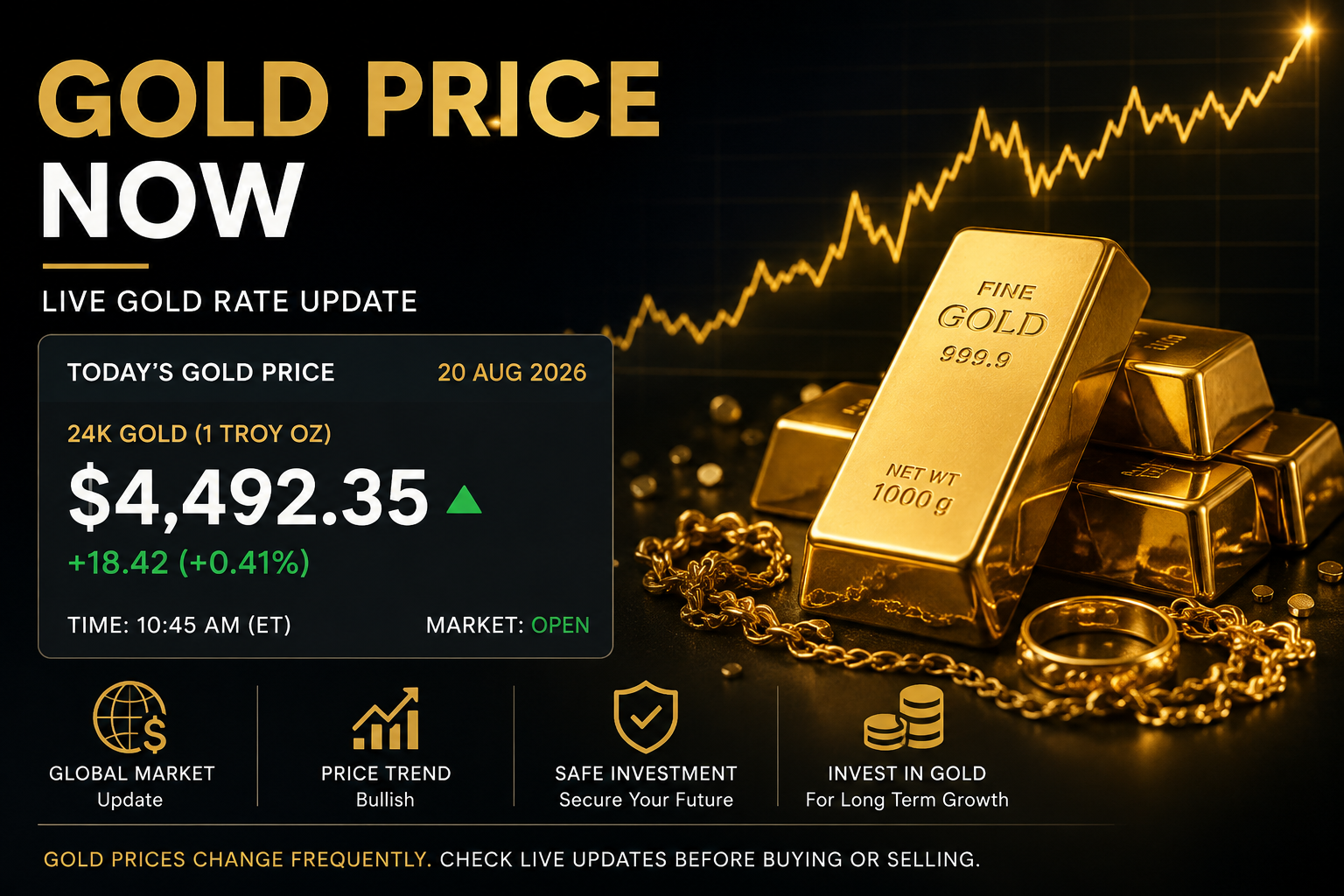
People searching for gold price now usually want one thing: the latest value of gold. However, understanding the number on a live chart is just as important as seeing the price itself.
Gold does not have one fixed price worldwide. The international spot price acts as a benchmark, but the amount you pay for a gold bar, coin, piece of jewelry, or local bullion product can be different. Dealer premiums, taxes, purity, making charges, transportation costs, and currency exchange rates can all affect the final price.
Gold has also experienced notable volatility in recent trading. On August 20, 2026, Reuters reported spot gold retreating to about $4,488 per ounce after reaching a more than two-month high above $4,525 earlier in the session.
This guide explains what the gold price means, how live rates are calculated, what moves the market, and how to check the most relevant price before buying or selling.
What Is the Gold Price Now?
The gold price now refers to the current market value of gold, usually based on the international spot price quoted in US dollars per troy ounce.
Unlike a fixed retail product, gold trades in a global market. Its value can move throughout the trading day as investors, central banks, institutions, manufacturers, and other market participants react to economic and political developments.
For context, gold traded around the mid-$4,400s per troy ounce on August 20, 2026, after moving above $4,500 during a strong rally. The exact price can change quickly, so anyone making a financial transaction should check a live market source immediately before acting.
A Simple Example
If spot gold is quoted at:
$4,500 per troy ounce
That does not automatically mean you can buy one ounce of physical gold for exactly $4,500.
A dealer may charge:
- The current spot price
- A premium for the physical product
- Shipping or handling costs
- Applicable taxes
The final purchase price may therefore be higher.
Understanding Spot Gold Prices
The spot price is the current market price for gold in large wholesale markets. It is commonly used as the starting point for pricing physical bullion and other gold-related products.
The symbol XAU/USD is widely used to represent the value of one troy ounce of gold in US dollars.
The London Bullion Market Association also provides an important benchmark. The LBMA Gold Price is independently administered through ICE Benchmark Administration and is set through auctions twice each business day.
Spot Price and Benchmark Price Are Not Always the Same
It is useful to understand the difference:
| Price Type | Meaning |
| Spot Gold Price | Current market value of gold |
| LBMA Gold Price | Benchmark price established through scheduled auctions |
| Futures Price | Price agreed for delivery at a future date |
| Retail Gold Price | Price charged to consumers for physical gold |
| Jewelry Price | Gold value plus craftsmanship and other costs |
For most people checking gold prices online, the live spot price provides the quickest picture of current market conditions.
Gold Price by Ounce, Gram, and Kilogram
Gold can be quoted using different units.
The most common international measurement is the troy ounce, which differs from the standard ounce used for many everyday products.
One troy ounce equals approximately 31.1035 grams.
Example Conversion
If gold were priced at $4,500 per troy ounce:
| Unit | Approximate Gold Value |
| 1 Troy Ounce | $4,500 |
| 1 Gram | $144.68 |
| 10 Grams | $1,446.80 |
| 1 Kilogram | $144,680 |
These figures are mathematical conversions only. Local market prices may differ because of currency movements, dealer margins, taxes, and product premiums.
What Moves the Price of Gold?
Several major factors influence the gold market.
1. Interest Rates and Bond Yields
Gold does not pay interest or dividends. Because of this, changes in interest rates and government bond yields can influence its attractiveness.
Higher yields may make interest-bearing investments more appealing, while lower yields can improve gold’s relative appeal.
Recent market movements have shown this relationship clearly. Gold’s August 2026 rally was supported by a weaker US dollar and declining Treasury yields.
2. The Strength of the US Dollar
Because gold is commonly priced in US dollars, changes in the dollar can affect international demand.
When the dollar weakens, gold can become relatively less expensive for buyers using other currencies. A stronger dollar can create the opposite effect.
3. Inflation Expectations
Investors sometimes view gold as a potential store of value during periods of inflation or currency uncertainty.
However, inflation does not automatically guarantee rising gold prices. The market also considers interest rates, economic growth, and expectations about future central-bank policy.
4. Geopolitical Events
Wars, trade disputes, financial instability, and political uncertainty can increase demand for assets considered safe havens.
Gold often receives attention during periods of uncertainty, although its price can still experience sharp short-term declines.
5. Central Bank Activity
Central banks hold gold as part of their reserves. Changes in official buying and selling can influence long-term market demand.
6. Investment Demand
Exchange-traded funds, institutional investors, futures traders, and individual buyers can all affect the market.
A sudden increase in buying or profit-taking can cause significant price movements.
Why Does the Gold Price Change During the Day?
Gold trades across major financial centers around the world, including Asia, Europe, and North America.
As different markets open and close, new economic information can influence prices.
Common triggers include:
- Inflation reports
- Employment data
- Central-bank announcements
- Interest-rate expectations
- Currency movements
- Bond yield changes
- Political developments
- Changes in investor sentiment
This is why the price you see in the morning may not match the price available later in the day.
Live market services such as Kitco display continuously updated spot-price charts, while benchmark providers such as LBMA publish structured benchmark information.
Spot Price vs. Retail Gold Price
One of the most common mistakes is assuming that the spot price equals the price of physical gold.
It usually does not.
Why Physical Gold Costs More
A physical gold product may include:
- Refining costs
- Manufacturing expenses
- Dealer premiums
- Transportation and insurance
- Storage costs
- Taxes, depending on location
For example, a one-ounce gold coin may sell above the spot price because the dealer must cover production and operating costs.
When selling gold, the amount offered may also be below the spot price.
Important Tip
Always compare the buy price and sell price, not just the headline spot price.
The difference between these two figures is often called the spread.
How to Check Gold Prices Accurately
If you need the current rate, use a reliable process.
Step 1: Check the International Spot Price
Look for the current XAU/USD quote from an established financial or bullion-market source.
Step 2: Confirm the Unit
Make sure you know whether the price is listed per:
- Troy ounce
- Gram
- Kilogram
- Tola
Step 3: Check the Purity
Gold purity matters.
Common forms include:
| Purity | Karat | Approximate Gold Content |
| 999 or 999.9 | 24K | Nearly pure gold |
| 916 | 22K | 91.6% gold |
| 750 | 18K | 75% gold |
| 585 | 14K | 58.5% gold |
A 24K gold price should not be directly compared with the value of an 18K jewelry item without adjusting for purity.
Step 4: Check Your Local Market
If you are buying physical gold, compare several reputable dealers.
The local price may be affected by:
- Exchange rates
- Import costs
- Local demand
- Taxes
- Dealer premiums
Should You Buy Gold Based on Today’s Price?
A single day’s price should not be the only reason to buy or sell gold.
Instead, consider:
- Your investment goal
- Your time horizon
- Your budget
- Portfolio diversification
- Storage costs
- Liquidity needs
- Price volatility
Someone buying gold for long-term diversification may approach the market differently from a short-term trader.
A practical approach is to decide in advance how much exposure to gold fits your overall financial plan. If you are considering a significant investment, professional financial advice may be appropriate.
Common Mistakes to Avoid
Buying Without Checking Purity
Always confirm the karat or fineness before comparing prices.
Confusing Spot Price With Retail Price
Physical gold normally includes a premium.
Using Outdated Prices
Gold can move significantly within a single day. Check the timestamp on any quoted price.
Ignoring Local Currency
A stable international gold price can still result in a changing local price if your currency moves against the US dollar.
Making Decisions Based Only on Headlines
Gold can rise sharply on breaking news and then reverse direction. Consider your financial objective rather than reacting only to short-term price movements.
Key Takeaways
- Gold price now usually refers to the current international spot price of gold.
- Gold is commonly quoted in US dollars per troy ounce.
- Prices can change throughout the global trading day.
- Interest rates, bond yields, the US dollar, inflation expectations, central-bank activity, and geopolitical events can influence gold.
- The price of physical gold is usually different from the spot price because of premiums and other costs.
- Always check purity, measurement units, and local currency before comparing prices.
- Use reliable live market sources when making time-sensitive decisions.
FAQs
What is the gold price now?
The gold price changes continuously during market trading. On August 20, 2026, spot gold traded around the mid-$4,400s per troy ounce after briefly reaching above $4,500. Check a live market source for the latest quote before buying or selling.
Why does the gold price change every day?
Gold reacts to global supply and demand, interest rates, currency movements, bond yields, inflation expectations, economic data, and geopolitical developments.
Is the spot price the same as the price of physical gold?
No. Physical gold usually costs more than the spot price because dealers add premiums and other expenses.
How many grams are in a troy ounce of gold?
One troy ounce equals approximately 31.1035 grams.
What is the difference between 24K and 22K gold?
24K gold is nearly pure gold, while 22K gold contains approximately 91.6% gold and is mixed with other metals for additional strength.
Where can I check a reliable gold price?
For benchmark information, the LBMA Gold Price provides information on the internationally recognized benchmark process. For live spot-market charts, Kitco’s Gold Price Chart provides continuously updated market information.
Conclusion
The gold price now is more than a single number on a chart. It reflects a global market influenced by economic data, interest rates, currencies, investor demand, central-bank activity, and world events.
Before buying or selling, check a current price from a reliable source and understand exactly what you are comparing. Confirm the unit, purity, currency, dealer premium, and final transaction price.
Gold can play different roles for different people, from jewelry purchases to long-term portfolio diversification. Whatever your goal, using current information and understanding how gold pricing works can help you make a more informed decision.
Learn About: Silver Futures
