
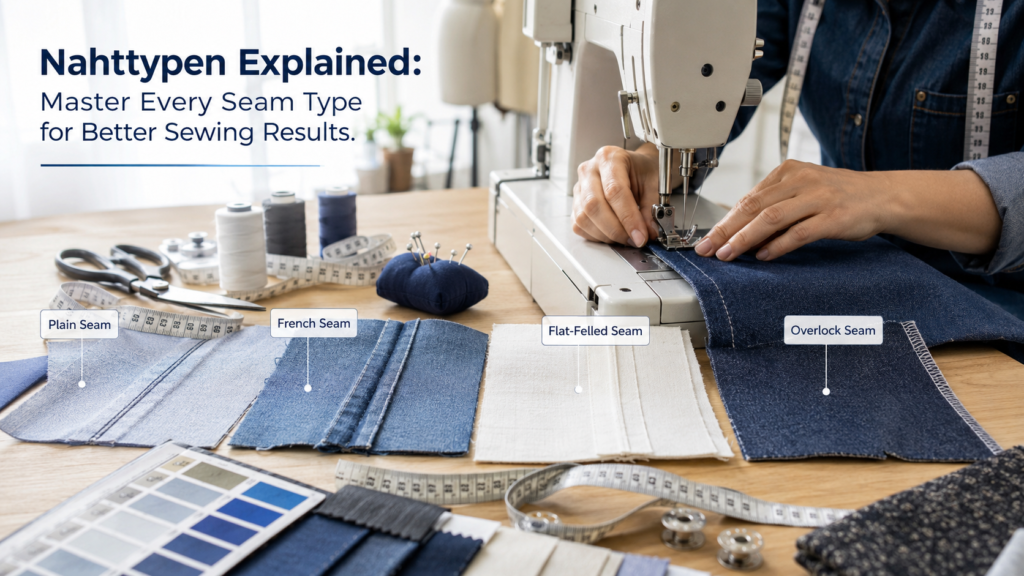
A seam may look like a simple line of stitches, but it plays an important role in how a garment or textile product looks, feels, and performs. The right seam can make clothing stronger, more comfortable, and more professional, while an unsuitable seam can cause bulk, fraying, discomfort, or even fabric damage.
The German term Nahttypen refers to different types or categories of seams used in sewing and textile construction. Understanding these seam types is useful for beginners, home sewers, fashion students, tailors, and anyone interested in garment production.
Each seam has its own characteristics. Some are designed for speed and simplicity, while others provide additional strength or hide raw fabric edges. Certain seams are particularly useful for delicate fabrics, whereas others work well for denim, workwear, bedding, or other heavy materials.
This guide explains the most common Nahttypen, where they are used, their advantages and limitations, and how to choose the right seam for a sewing project.
What Does Nahttypen Mean?
Nahttypen is a German term that translates to “seam types” or “types of seams.” In sewing, a seam is the area where two or more pieces of fabric are joined together with stitching.
Seams can differ according to:
- Construction method
- Stitch type
- Strength
- Appearance
- Fabric thickness
- Edge finishing
- Intended use
For example, a simple plain seam may be enough for a lightweight blouse, while a flat-felled seam can be more appropriate for jeans or durable shirts.
Understanding Nahttypen helps you select a construction method rather than simply using the same seam for every project.
Why Are Seam Types Important?
Choosing the right seam affects much more than appearance.
Strength and Durability
A well-constructed seam should withstand normal movement and repeated washing. Garments such as trousers, jackets, and workwear often require stronger seam constructions than decorative items.
Comfort
Some seam finishes create raised or bulky areas on the inside of clothing. This may be uncomfortable, especially in garments worn directly against the skin.
Appearance
Visible stitching can become a design feature. In other cases, the goal is to create a clean finish where the seam is barely noticeable.
Fabric Protection
Certain fabrics unravel easily when cut. A suitable seam finish can help protect raw edges and improve the lifespan of the finished item.
Common Nahttypen in Sewing
There are many seam constructions, but several are especially common in clothing and textile production.
1. Plain Seam
The plain seam is one of the simplest and most widely used seam constructions.
Two fabric pieces are placed with their right sides facing each other and stitched along the seam line. The fabric is then opened and pressed flat.
Common uses include:
- Shirts
- Dresses
- Skirts
- Lightweight trousers
- Home sewing projects
Its main advantage is simplicity. It is easy to sew and suitable for many fabrics.
However, the raw edges usually require additional finishing to prevent fraying.
2. French Seam
A French seam encloses the raw fabric edges inside the seam allowance. This creates a neat finish on both the inside and outside of the garment.
It is particularly useful for lightweight or delicate fabrics.
Typical applications include:
- Blouses
- Dresses
- Lingerie
- Lightweight garments
- Sheer fabrics
The finished result looks clean and professional. The trade-off is that French seams require more steps and can create unnecessary bulk in thick fabrics.
3. Flat-Felled Seam
A flat-felled seam is a strong seam construction in which the raw edges are enclosed and the seam lies relatively flat.
This type of seam is commonly associated with durable garments such as jeans and work shirts.
Benefits include:
- Excellent durability
- Clean enclosed edges
- Reduced fraying
- Professional appearance
Because it is strong and neat, it is particularly valuable in garments that experience frequent movement and washing.
4. Overlocked or Serger Seam
An overlock seam uses an overlock machine, commonly called a serger, to stitch and finish the fabric edge at the same time.
The machine trims excess fabric while wrapping thread around the edge.
This technique is widely used in modern garment manufacturing and home sewing.
It works especially well with:
- Knitted fabrics
- Stretch fabrics
- T-shirts
- Casual clothing
- Seams requiring quick edge finishing
An overlock finish can prevent raw edges from unraveling while creating a flexible construction.
5. Lapped Seam
In a lapped seam, one fabric edge overlaps another rather than placing the two pieces together in the conventional way.
The overlapping section is then secured with stitching.
Lapped seams can be useful when a strong, relatively flat construction is needed or when the seam itself forms part of the garment’s visual design.
They are also used in some leather, upholstery, and heavy-fabric applications.
6. Bound Seam
A bound seam uses an additional strip of fabric or binding to cover a raw edge.
This produces a neat finish and can add a decorative element.
Bound seams are often useful when the inside of a garment needs to look particularly polished.
They may appear in:
- Jackets
- Coats
- Unlined garments
- Bags
- Home textiles
7. Welt Seam
A welt seam can create a raised or decorative appearance while providing a structured finish.
It is often associated with tailored garments and detailed textile construction.
Because welted constructions require accuracy, they are generally more suitable for intermediate or advanced sewing projects.
How Different Seams Compare
| Seam Type | Main Benefit | Common Uses | Difficulty |
| Plain Seam | Simple and versatile | Dresses, shirts, skirts | Easy |
| French Seam | Clean enclosed edges | Lightweight garments | Medium |
| Flat-Felled Seam | Strong and durable | Jeans, work shirts | Medium |
| Overlock Seam | Fast edge finishing | Knits, casualwear | Easy–Medium |
| Lapped Seam | Strong overlapping construction | Heavy fabrics, garments | Medium |
| Bound Seam | Neat and attractive finish | Jackets, bags, textiles | Medium |
| Welt Seam | Structured and decorative | Tailoring, detailed garments | Advanced |
The “best” seam is not universal. A construction that works beautifully on silk may be unsuitable for thick denim.
How to Choose the Right Seam
When selecting between different Nahttypen, consider the following factors.
Fabric Weight
Lightweight fabrics generally benefit from lightweight seam constructions. Heavy materials may require stronger seams designed to handle additional stress.
Fabric Fraying
If the fabric frays easily, choose a seam or finishing method that protects the raw edge.
For example, an overlock finish can be useful for fabrics that unravel significantly.
Stretch
Stretch fabrics require construction methods that can accommodate movement. A rigid seam may break when the garment stretches.
Garment Purpose
Think about how the finished garment will be used.
A decorative blouse does not necessarily need the same seam construction as industrial workwear.
Appearance
Ask whether the seam should be visible or hidden.
A flat-felled seam can create visible parallel stitching, while a French seam offers a cleaner interior finish.
Sewing Equipment
Your machine also affects your options. A standard sewing machine can handle many seam constructions, while an overlock machine provides specialized edge finishing.
Seam Finishing Techniques
A seam is not always complete when the main stitching is finished. Raw edges may need additional treatment.
Common finishing methods include:
- Zigzag stitching
- Overlocking
- Pinked edges
- Binding
- Turned-and-stitched edges
- Enclosed seam constructions
The purpose is generally to control fraying and improve durability.
Pressing Matters
Pressing is one of the easiest ways to improve the appearance of a seam.
After stitching, carefully press the seam according to the fabric’s requirements. Proper pressing helps create accurate shapes and cleaner garment construction.
Always consider the fabric’s heat sensitivity before using an iron.
Common Sewing Mistakes
Even a technically correct seam can look poor if basic sewing practices are ignored.
Incorrect Seam Allowance
An inconsistent seam allowance can affect garment fit and alignment. Use the pattern’s recommended measurement and maintain it consistently.
Skipping Pressing
Sewing without pressing can leave seams uneven or bulky. Pressing after important construction steps usually produces a more professional result.
Using the Wrong Needle
Needle choice should match the fabric. Lightweight materials may require a finer needle, while heavier fabrics generally need a stronger needle designed for the material.
Ignoring Grain Direction
Fabric grain can influence how a garment hangs and behaves. Cutting pieces incorrectly can cause twisting or distortion regardless of how carefully the seam is sewn.
Choosing Strength Over Comfort
A very strong seam is not automatically the best choice. In clothing, comfort matters too. A bulky interior construction may be unsuitable for areas that frequently touch the skin.
Tips for Better Seams
For consistently cleaner results:
- Test your seam first on a fabric scrap.
- Use the correct needle and thread for the material.
- Maintain a consistent seam allowance.
- Avoid pulling the fabric while sewing.
- Press seams during construction, not only at the end.
- Finish raw edges when the fabric requires it.
- Check seam strength before completing the garment.
- Choose construction based on function, not appearance alone.
A few minutes spent testing and pressing can make a noticeable difference in the final result.
Key Takeaways
- Nahttypen means types of seams in German.
- Seam selection affects durability, comfort, appearance, and fabric performance.
- Plain seams are versatile and beginner-friendly.
- French seams are excellent for clean finishes on lightweight fabrics.
- Flat-felled seams provide strong construction for durable garments.
- Overlock seams efficiently finish raw edges and work well with many knit fabrics.
- Bound and lapped seams can provide both practical and visual benefits.
- The best seam depends on the fabric, garment purpose, desired appearance, and available equipment.
- Proper pressing and seam finishing are essential parts of quality sewing.
FAQs
What are Nahttypen?
Nahttypen is the German term for types of seams. It describes the different methods used to join fabric pieces together during sewing and textile construction.
What is the most common type of seam?
The plain seam is one of the most common seam constructions because it is simple, versatile, and suitable for many types of garments and fabrics.
Which seam is best for delicate fabric?
A French seam is often a good choice for lightweight or delicate fabrics because it encloses the raw edges and creates a neat interior finish. The suitability still depends on the specific fabric.
Which seam is strongest for clothing?
A flat-felled seam is known for strong, durable construction and is commonly used in garments that need to withstand considerable wear, such as jeans and work shirts.
What is an overlock seam used for?
An overlock seam is commonly used to finish raw fabric edges and can be especially useful for knit and stretch fabrics. An overlock machine can trim and finish the edge in one operation.
Why should seams be pressed?
Pressing helps flatten and shape seams, making the finished garment more accurate and professional-looking. It can also reduce unwanted bulk and improve how pieces fit together.
Can one garment use different seam types?
Yes. A garment can use several seam constructions. The designer or sewer may select different Nahttypen based on the location of the seam, fabric characteristics, strength requirements, and desired appearance.
Conclusion
Understanding Nahttypen gives sewers a practical foundation for making better construction decisions. A seam is not simply a row of stitches; it can influence the strength, comfort, appearance, and lifespan of a finished textile product.
From the straightforward plain seam to the enclosed French seam and durable flat-felled seam, each construction has a particular purpose. Overlock, bound, lapped, and welt seams provide additional options when different fabrics or design requirements call for them.
The key is to match the seam to the project. Consider the fabric, amount of stress, desired finish, garment purpose, and equipment available before choosing a construction method. With practice, understanding different seam types becomes an important part of creating clean, durable, and professional-looking sewing projects.
Learn About: Fashion Design Software
