
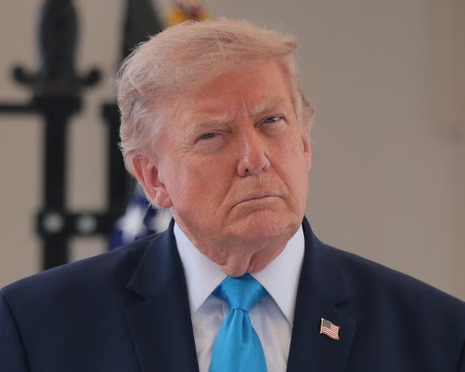
Donald Trump has remained a prominent and often debated figure in American public life for decades. Known for his career in business, television, and politics, he has built a public image that continues to attract significant attention both in the United States and internationally.
His political career has been marked by major policy debates, strong public reactions, and a distinctive communication style that has kept him at the center of national conversations. From his first presidential campaign to his role in shaping the modern Republican Party, Trump has had a lasting impact on American politics.
His supporters often point to his approach to economic and national policy, while his critics have raised concerns about several aspects of his leadership and political rhetoric. This combination of influence and controversy has made his career a subject of continued public interest.
Donald Trump — Quick Facts
| Category | Details |
| Name | Donald John Trump |
| Born | June 14, 1946 |
| Birthplace | Queens, New York |
| 🇺🇸 Role | 47th U.S. President |
| Previous Term | 2017–2021 |
| Career | Businessman & TV Personality |
| Known For | The Apprentice |
| Party | Republican |
| Wife | Melania Trump |
| Children | 5 |
Early Life and Business Career
Donald John Trump was born in Queens, New York, in 1946. He later attended the University of Pennsylvania’s Wharton School before entering the real estate business.
His father, Fred Trump, was already an established property developer, and Trump followed that path while eventually building a public identity of his own.
New York became the center of his business career. Hotels, office buildings, residential properties, golf resorts, and other ventures became associated with the Trump name.
But the business side was only part of the picture.
Trump understood branding unusually well. His name became almost a product itself, appearing on buildings, golf courses, books, television programs, and merchandise. That ability to remain visible would later become extremely useful when he entered politics.
The Art of the Deal
One of the best-known books associated with Trump is The Art of the Deal, published in 1987. The book helped strengthen his reputation as a successful businessman and made his name familiar to an audience far beyond New York.
For many people, that was probably their first real introduction to him.
The Television Years
Before becoming president, Trump became a familiar face on American television through The Apprentice.
The reality show premiered in 2004 and centered on business-oriented challenges, with Trump serving as its host and judge.
Television changed the way many Americans viewed him. He wasn’t simply a businessman mentioned in newspapers anymore. Viewers saw his personality directly — the confidence, the blunt comments, the dramatic moments and, sometimes, the arguments.
That kind of exposure matters in politics.
People often feel that they know a television personality before they know much about their actual political record. Trump entered presidential politics with something most candidates spend years trying to build: instant name recognition.
Entering Presidential Politics
Trump announced his campaign for president in 2015 and ran as a Republican.
His campaign quickly became one of the most talked-about political movements in recent American history. Immigration, trade, national security, manufacturing, and opposition to the political establishment were major themes.
His “Make America Great Again” message connected strongly with many voters, particularly those who felt that Washington politicians had ignored their concerns.
Others strongly rejected his approach and rhetoric.
That split followed him throughout his political career.
The First Presidency
Trump won the 2016 presidential election and took office in January 2017 as the 45th president.
His first administration focused on several major areas, including immigration policy, tax changes, deregulation, trade, energy, and foreign relations. The administration also replaced NAFTA with the United States-Mexico-Canada Agreement, commonly called USMCA.
His presidency was rarely quiet.
There were major policy fights in Washington, tense relationships with the media, investigations, impeachment proceedings, protests, and intense disagreements between supporters and critics.
For supporters, his willingness to challenge established political norms was part of the appeal.
For opponents, those same habits were a major reason for concern.
The 2020 Election and Years Outside the White House
Trump lost the 2020 presidential election to Joe Biden.
The period that followed was politically intense, particularly because Trump continued to dispute the election result. The aftermath of the 2020 election remained a major issue in American political debate for years.
Yet his political movement didn’t disappear.
Instead, he remained highly influential within the Republican Party and eventually launched another presidential campaign.
That comeback became one of the defining chapters of his political career.
A Historic Return to the White House
In the 2024 election, Trump defeated Democratic nominee Kamala Harris and returned to the presidency in January 2025. The White House identifies him as the 45th and 47th president of the United States.
There is something unusual about a nonconsecutive return like this. Grover Cleveland was the only earlier U.S. president to serve two nonconsecutive terms, so Trump’s return placed him in a very small group in American presidential history.
His second administration has focused heavily on immigration, border enforcement, energy, trade, government spending, national security, and changes to federal policy.
The administration has also placed strong emphasis on artificial intelligence, economic investment, and reshaping federal agencies.
A Different Political Environment
Trump’s second term began in a political environment very different from 2017.
Social media plays an even larger role. Political arguments move faster. News cycles change almost hourly.
And Trump remains unusually active in public communication, which means a statement made in the morning can become the subject of national discussion by lunchtime.
That’s probably one reason his presidency continues to attract attention far beyond traditional political circles.
Immigration and Border Policy
Immigration has been one of Trump’s most consistent political themes.
During both presidential campaigns and administrations, he has argued for tighter border controls and stronger immigration enforcement. His second administration has made border security a central priority.
The White House says its current policies have sharply reduced illegal border crossings and increased enforcement. Those claims come from the administration itself and remain part of an ongoing political debate.
For supporters, stronger enforcement represents a long-promised change.
Critics, meanwhile, have raised concerns about the treatment of migrants and the broader humanitarian consequences of immigration policy.
It’s an issue where political opinions can become very personal, especially for families directly affected by immigration rules.
Economic and Trade Policies
Economic policy has also been a major part of Trump’s political identity.
His approach generally emphasizes lower regulation, domestic production, American energy, and protection of U.S. industries.
Tariffs and trade negotiations have received particular attention during his political career. Trump has often argued that tariffs can encourage companies to manufacture goods in the United States and protect American workers.
Critics argue that tariffs can also raise costs for businesses and consumers.
So, like many parts of his presidency, the economic debate isn’t quite as simple as one headline makes it sound.
Why Trump Remains So Influential
There’s a reason people who don’t follow politics closely still know Trump’s name.
He’s good at getting attention.
Whether it’s a campaign rally, television interview, social media post, presidential speech, or political dispute, Trump tends to generate a reaction. His communication style is direct, sometimes provocative, and very different from the polished language traditionally associated with American politicians.
That has worked both for him and against him.
His supporters often see him as someone willing to say what other politicians won’t.
His critics see the same behavior as unnecessarily divisive.
Either way, the attention rarely stops.
Family and Public Life
Trump’s family has also remained visible throughout his career. He has five children: Donald Jr., Ivanka, Eric, Tiffany, and Barron, and the White House says he has 11 grandchildren.
His wife, Melania Trump, served as first lady during his first presidency and returned to the role when Trump began his second term.
Family members have appeared in business, politics, campaigns, and public events over the years, making the Trump family one of the more recognizable political families in modern America.
Looking at His Legacy
It may still be too early to give a final judgment on Trump’s historical legacy.
He’s still president, and major policies from his second administration are still unfolding.
What can be said already is that his impact on American politics is significant. He changed the Republican Party, influenced political communication, reshaped debates around immigration and trade, and demonstrated that a political outsider with enormous name recognition could reach the White House.
Whether history ultimately views those changes positively or negatively will depend on how people judge the results — and, honestly, on which part of his presidency they focus on.
Final Thoughts
The story of Donald Trump is much bigger than a single election or political slogan.
It stretches from New York real estate to television, from business branding to presidential campaigns, and from a first term in the White House to an unusual return for a second nonconsecutive term.
He’s a figure who continues to divide opinion, attract enormous media attention, and influence political conversations far beyond Washington.
Whatever someone thinks of his policies or personality, it’s hard to argue that his career hasn’t left a noticeable mark on American public life.
And his political story isn’t finished yet.
FAQs
Who is Donald Trump?
Donald Trump is an American businessman, television personality, and politician who is serving as the 45th and 47th president of the United States. He first became president in 2017 and returned to office in January 2025.
How many times has Trump been president?
Trump has served two nonconsecutive terms. He became the 45th president in 2017 and the 47th president in 2025.
What was Trump known for before politics?
Before entering presidential politics, Trump was widely known for his real estate business, branding ventures, books, and his role as host of The Apprentice.
What is Trump known for politically?
His political platform has emphasized issues such as immigration enforcement, border security, trade, deregulation, energy production, and an “America First” approach to government and foreign policy.
Who is Melania Trump?
Melania Trump is Trump’s wife and the current first lady of the United States. She previously served as first lady from 2017 to 2021 and returned to the role when Trump began his second term.
Is Trump still president in 2026?
Yes. As of August 2026, Donald Trump is serving his second term as president of the United States.
Read More About: Steven Cauble
